Impact of hydroxyurea on hospitalization frequency among homozygous sickle cell patients at Makala General Referral Hospital, Kinshasa, Democratic Republic of the Congo
Sissy Tambani-Kindja, Junior Bulabula-Penge, Dariz Riziki-Tshimbalanga, Ange Ngonde-Mambakasa, Christophe Luhata-Lungayo
Corresponding author: Sissy Tambani-Kindja, École Franco-Congolaise des Hautes Études de Santé Publique, Université Protestante au Congo, Kinshasa, Democratic Republic of the Congo 
Received: 22 Nov 2025 - Accepted: 25 Sep 2026 - Published: 12 Oct 2026
Domain: Biostatistics
Keywords: Sickle cell disease, hydroxyurea, hospitalization, Democratic Republic of the Congo
Funding: This work received no specific grant from any funding agency in the public, commercial, or non-profit sectors.
©Sissy Tambani-Kindja et al. Pan African Medical Journal (ISSN: 1937-8688). This is an Open Access article distributed under the terms of the Creative Commons Attribution International 4.0 License (https://creativecommons.org/licenses/by/4.0/), which permits unrestricted use, distribution, and reproduction in any medium, provided the original work is properly cited.
Cite this article: Sissy Tambani-Kindja et al. Impact of hydroxyurea on hospitalization frequency among homozygous sickle cell patients at Makala General Referral Hospital, Kinshasa, Democratic Republic of the Congo. Pan African Medical Journal. 2026;55:75. [doi: 10.11604/pamj.2026.55.75.50324]
Available online at: https://www.panafrican-med-journal.com//content/article/55/75/full
 PDF in process
 Research 

Impact of hydroxyurea on hospitalization frequency among homozygous sickle cell patients at Makala General Referral Hospital, Kinshasa, Democratic Republic of the Congo
Impact of hydroxyurea on hospitalization frequency among homozygous sickle cell patients at Makala General Referral Hospital, Kinshasa, Democratic Republic of the Congo
Sissy Tambani-Kindja1,2,&, Junior Bulabula-Penge3,4, Dariz Riziki-Tshimbalanga1,3, Ange Ngonde-Mambakasa2, Christophe Luhata-Lungayo5
&Corresponding author
Introduction: homozygous sickle cell disease is a serious inherited condition that causes frequent painful crises and repeated hospitalizations, contributing to high illness and death rates in sub-Saharan Africa. Although hydroxyurea is known to lessen the number and severity of these complications, its use remains limited in the Democratic Republic of the Congo (DRC). This study aimed to assess the impact of hydroxyurea on hospitalization rates among patients with SS sickle cell disease.
Methods: we conducted a retrospective cohort study. Sociodemographic and clinical characteristics were described based on treatment status. Associations between hydroxyurea use and hospitalizations were assessed using logistic and Poisson (or quasi-Poisson) regression models. Kaplan-Meier survival curves and Cox proportional hazards models were employed to evaluate time to first hospitalization.
Results: a total of 212 patients with sickle cell disease, aged 2 to 45 years and followed at Makala General Referral Hospital between 2020 and 2024, were included in the analysis. Hydroxyurea use was not significantly associated with either the risk (ORa = 0.72; 95% CI: 0.31 -1.64; p = 0.4) or the frequency of hospitalizations after adjustment (ORa = 1.04; 95% CI: 0.57-2.02; p > 0.9). Survival analysis revealed no significant difference in the time to first hospitalization between treated and untreated patients. (Log-rank p = 0.46). However, vaso-occlusive crises and blood transfusions were significant predictors of hospitalization.
Conclusion: hydroxyurea did not demonstrate a statistically significant effect on hospitalization rates. However, hydroxyurea remains a crucial part of sickle cell disease management. Improving access to this treatment, ensuring regular laboratory monitoring, and increasing awareness among patients and their families are vital steps to reduce the burden of illness and decrease deaths associated with sickle cell disease in the DRC.

Sickle cell disease (SCD) is an inherited disorder passed on in an autosomal recessive pattern, caused by a point mutation in the β-globin gene that produces an abnormal form of hemoglobin known as HbS [1]. When oxygen levels drop, HbS molecules polymerize, leading to the deformation of red blood cells, blood vessel blockage, and chronic hemolysis [2]. The homozygous form (HbSS), or sickle cell anemia, is the most severe and is most common in sub-Saharan Africa [3]. In contrast, compound heterozygous forms such as HbSC or HbSβ-thalassemia tend to cause milder disease [4]. Carriers of the sickle cell trait (AS) usually have no symptoms but continue to transmit the gene in regions where the disease is highly prevalent [5].
Diagnosis is ideally made through newborn screening, when available, or through evaluation of unexplained anemia and recurrent pain episodes [6]. Yet, in many African countries, sickle cell disease often goes undiagnosed. In Kinshasa, for example, 5% of children admitted for severe anemia were later found to have previously unrecognized SCD [7]. Similarly, in Nigeria, around 10% of anemic children between 6 months and 5 years of age carried the sickle cell gene [3]. Vaso-occlusive crises are the main cause of hospitalization and a key severity marker [8].
Globally, SCD is the most frequent hereditary blood disorder, affecting millions of people [9,10]. Approximately 300,000 children are born annually with SCD, more than two-thirds in sub-Saharan Africa [1,11]. Without adequate care, 50-90% of affected children die before age five [12-14]. Most births occur in Nigeria, the Democratic Republic of Congo, and India [4]. The World Health Organization (WHO) has recognized sickle cell disease (SCD) as a global public health priority since 2005 [8]. Hydroxyurea, introduced in the 1980s, remains the cornerstone treatment that can alter the course of sickle cell disease [10,13]. Hydroxyurea helps the body make more fetal hemoglobin (HbF), which keeps red blood cells stable for longer, reduces painful vaso-occlusive crises, and improves patients’ chances of survival [10]. In 2024, the World Health Organization (WHO) recommended introducing hydroxyurea early in children with sickle cell disease as part of its Sickle Cell Disease Intervention Package for sub-Saharan Africa [1]. Still, in many low-resource countries, access to hydroxyurea remains difficult because of high costs, recurring shortages, limited laboratory infrastructure, and a shortage of trained healthcare professionals [1].
Because of these challenges, this study focused on assessing the effect of hydroxyurea on hospitalization frequency among patients with homozygous sickle cell disease in Kinshasa. The main research question of this study was: Does hydroxyurea treatment reduce the hospitalization frequency among patients with homozygous sickle cell disease (SS) aged 2-45 years?

Study design: we conducted a retrospective cohort study from January 1, 2020, to December 31, 2024.
Study framework: this study was conducted at the Sickle Cell Unit of the Makala General Referral Hospital (HGR Makala), located in the Selembao commune of Kinshasa, the capital city of the Democratic Republic of the Congo. HGR Makala is a public hospital located at the frontline of the health system and operates under the supervision of the Selembao Health Zone. The hospital provides a variety of specialized services, including surgery, internal medicine, pediatrics, obstetrics and gynecology, physiotherapy, ophthalmology, and dentistry, as well as a dedicated unit for patients with sickle cell disease, among others.
Study population: the study population included all homozygous sickle cell (SS) patients who consulted at Makala General Referral Hospital during the study period.
Inclusion criteria: patients with homozygous sickle cell disease (SS), aged 2 to 45 years, and with a confirmed diagnosis by hemoglobin electrophoresis, were included in the study, whether or not they were receiving hydroxyurea treatment.
Exclusion criteria: excluded from the study were SS patients who were pregnant or breastfeeding, those younger than 2 years or older than 45 years, and patients with a history of allergy to hydroxyurea or any of its components.
Data collection: information for this study was collected retrospectively from patient consultation notes and hospital registers. A structured data entry template was used to collect the relevant information. The data included sociodemographic variables such as age and sex, as well as clinical variables like dates of hospital admissions, number of hospitalizations, occurrence of vaso-occlusive crises, blood transfusions, and hydroxyurea treatment status. All data were carefully organized into a structured database to facilitate analysis.
Statistical analysis: to address the main research question regarding the effect of hydroxyurea on hospitalization frequency, the number of hospitalizations per patient during the study period was analyzed using Poisson or quasi-Poisson regression models to account for overdispersion in count data. Additionally, the risk of experiencing at least one hospitalization was examined using logistic regression models. The time to first hospitalization was analyzed using Kaplan-Meier survival curves and log-rank tests, and Cox proportional hazards models were used to estimate hazard ratios. Multivariate analyses included variables with p ≤ 0.20 in univariate analysis or those considered clinically relevant. Statistical significance was set at p < 0.05. All analyses were performed using R software (version 4.4.1).
Ethical considerations: the research protocol of this study was submitted to and approved by the Ethics Committee of the Protestant University in Congo, which issued an authorization certificate under reference number CEUPC 0216. Since this study is retrospective, it did not expose patients to any additional risk. The data were collected from consultation records and existing hospital registries. To preserve the confidentiality and integrity of the information, all data were anonymized and processed exclusively for research purposes.
Sociodemographic and clinical characteristics: a total of 212 homozygous SS patients were included, of whom 137 (64.6%) received hydroxyurea. The drug was most often prescribed to children aged 6–12 years. Patients treated with hydroxyurea showed greater disease severity: 40% experienced more than two vaso-occlusive crises compared to 16% in the untreated group (Table 1). More extended hospital stays (more than 5 days) were also more frequent among treated patients.
Association between hydroxyurea and hospitalization risk: neither univariate nor multivariate logistic regression showed a significant link between hydroxyurea use and hospitalization risk (adjusted OR = 0.72; 95% CI: 0.31-1.64; p = 0.4). Conversely, vaso-occlusive crises and blood transfusions were strongly associated with hospitalization (Table 2).
Hospitalization frequency: Poisson or quasi-Poisson analyses showed no significant association between hydroxyurea and hospitalization frequency (adjusted RR = 1.04; 95% CI: 0.57-2.02; p > 0.90). However, patients who had no crises or fewer than two crises had significantly lower hospitalization rates (adjusted RR = 0.05 and 0.23; p < 0.001) Table 3).
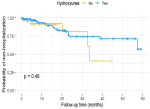
Survival analysis: the Kaplan-Meier curve showed a non-significant trend toward longer hospitalization-free survival among treated patients (log-rank p = 0.46) (Figure 1). The Cox model indicated a 45% reduced risk of first hospitalization with hydroxyurea (adjusted HR = 0.55; 95% CI: 0.21-1.43; p = 0.20), although this was not statistically significant. Patients with fewer vaso-occlusive crises had a notably lower risk of first hospitalization (adjusted HR = 0.16; 95% CI: 0.05-0.46; p < 0.001).
Main findings: hydroxyurea was not significantly linked to a decrease in hospitalization rates among homozygous SS patients in this group. Instead, vaso-occlusive crises and transfusion requirements were the primary factors predicting hospitalization. The lack of a notable benefit might be due to inconsistent treatment, adherence issues, and limited biological monitoring in this low-resource setting.
Strengths and weaknesses: among the strengths of this study is the comprehensiveness of the sample over five years. The use of real hospital data allows for a better understanding of the management dynamics in this context. In addition, the use of rigorous statistical methods (logistic regression, Poisson and quasi-Poisson models, survival analyses) integrates key clinical variables, such as vaso-occlusive crises and blood transfusions. The study also provides rare data on the effectiveness of hydroxyurea in a low-resource context. The limitations include the retrospective nature of the study, the lack of formal adherence measurement, indication bias due to prescribing to the most severe patients, the absence of a randomized study, limited information on the dose and duration of treatment, and possible underreporting of complications. Furthermore, irregular biological monitoring and frequent treatment interruptions in this setting may have attenuated the observed impact.
Comparison with other studies: the results of this study differ from those reported in several countries, where hydroxyurea has been shown to significantly reduce painful crises, transfusions, and hospitalizations. This includes studies conducted in India, Nigeria, and the United States, where regular follow-up, therapeutic adherence, and drug availability are better ensured [10,15,16]. However, in several low-resource African countries, findings similar to ours have been reported [9]. These studies also highlight that limited access to hydroxyurea [13], treatment costs, frequent supply interruptions, and lack of regular biological monitoring compromise its real-world effectiveness [17]. Our results, therefore, reflect a structural reality in many sub-Saharan contexts.
Explanation of observed differences: the lack of a statistically significant effect of hydroxyurea on hospitalizations observed in our study may partly be explained by indication bias: treated patients are often those with the most severe forms of the disease, which can mask the treatment's benefits. Moreover, irregular biological monitoring and treatment interruptions may reduce the expected therapeutic effectiveness. The strong association observed between the frequency of vaso-occlusive crises, blood transfusions, and hospitalization risk confirms that these complications remain the most reliable markers of clinical severity.
Study significance: the lack of a statistically significant effect of hydroxyurea on hospitalization frequency in this cohort underscores the importance of improving both access to treatment and the quality of follow-up for sickle cell patients, particularly through enhanced support to ensure optimal adherence. Health systems in the DRC and other low-resource countries must integrate mechanisms for continuous and accessible distribution of hydroxyurea, along with simplified but regular biological monitoring. However, emphasis must be placed on raising awareness among patients, families, and healthcare providers to convey the treatment's benefits better and encourage its acceptance. These measures are essential to reduce morbidity and mortality associated with sickle cell disease at the community level.
Unanswered questions and future research: prospective, ideally randomized, studies with rigorous monitoring of treatment adherence and biological parameters are needed to better assess the real-world clinical effectiveness of hydroxyurea in African settings. Further investigations into barriers to consistent access to treatment, factors influencing adherence, and dosing regimens adapted to local contexts are also recommended. A better understanding of how community initiatives can improve patient adherence and biological monitoring is a key step toward more sustainable and effective management of sickle cell disease.
This study did not find a statistically significant decrease in hospitalization rates among SS patients treated with hydroxyurea at Makala General Referral Hospital. This finding may partly be explained by contextual challenges common in low-resource settings, including indication bias (where the most severe patients are more likely to receive treatment), suboptimal treatment adherence, and irregular biological monitoring. However, hydroxyurea remains essential for comprehensive SCD management. Enhancing access to the drug, improving patient adherence, and ensuring regular clinical and laboratory follow-up are crucial steps to optimize its effectiveness and reduce the burden of sickle cell disease in the Democratic Republic of the Congo.
What is known about this topic
- Numerous clinical trials in high-income countries, along with some African studies (e.g., REACH and NOHARM), have demonstrated its effectiveness and safety, even at low doses;
- However, in low-resource settings like the DRC, its use remains limited due to costs, supply shortages, lack of regular biological monitoring, and low awareness among families and healthcare providers;
- Few local studies have documented its real-world impact on clinical outcomes, especially regarding the reduction of hospitalization frequency under routine care conditions.
What this study adds
- This study provides real-world evidence from Kinshasa based on a cohort of 212 homozygous sickle cell patients followed between 2020 and 2024;
- Hydroxyurea use was not significantly associated with hospitalization risk or hospitalization frequency after multivariate adjustment;
- Vaso-occlusive crises and blood transfusions were the strongest predictors of hospitalization in this cohort.
The authors declare no competing interests.
Study design: Sissy Tambani-Kindja, Christophe Luhata-Lungayo. Data collection and analysis: Sissy Tambani-Kindja, Junior Bulabula-Penge, Ange Ngonde-Mambakasa, Dariz Riziki-Tshimbalanga. Manuscript drafting: Sissy Tambani-Kindja, Junior Bulabula-Penge. Manuscript review and approval: All authors have read and approved the final version of this manuscript.
The authors want to express their sincere gratitude to the École Franco-Congolaise des Hautes Études de Santé Publique (EFCHESP), a partnership between the Université Protestante au Congo and the Université Paris-Saclay, as well as to the faculty of the Master’s program in Methodology and Statistics in Biomedical Research, and to the staff of Makala General Referral Hospital.
Table 1: sociodemographic and clinical characteristics of homozygous sickle cell disease patients according to hydroxyurea use at Makala General Referral Hospital, Kinshasa, Democratic Republic of the Congo, 2020-2024 (n = 212)
Table 2: logistic regression model: factors associated with hospitalization risk among homozygous sickle cell disease patients at Makala General Referral Hospital, Kinshasa, Democratic Republic of the Congo, 2020-2024 (n = 212)
Table 3: Poisson (quasi-Poisson) regression model: factors associated with the number of hospitalizations among homozygous sickle cell disease patients at Makala General Referral Hospital, Kinshasa, Democratic Republic of the Congo, 2020-2024 (n = 212)
Figure 1: Kaplan-Meier survival curves showing time to first hospitalization according to hydroxyurea exposure (Yes = treated patients; No = untreated patients)
- Arlet JB, Bernaudin F, Deme-Ly I, Coulibaly B, Corbasson A, Diagne I et al. Use of hydroxyurea in French-speaking Sub-Saharan Africa. Ann Hematol. 2025 Feb 1;104(2):937-41. PubMed | Google Scholar
- Rees DC, Williams TN, Gladwin MT. Sickle-cell disease. 2010;376:2018-49. PubMed | Google Scholar
- Oron AP, Chao DL, Ezeanolue EE, Ezenwa LN, Piel FB, Ojogun OT et al. Caring for Africa's sickle cell children: Will we rise to the challenge. BMC Med . 2020 Apr 28;18(1):92. PubMed | Google Scholar
- Piel FB, Steinberg MH, Rees DC. Sickle Cell Disease. Longo DL, editor. New England Journal of Medicine. 2017 Apr 20;376(16):1561-73. Google Scholar
- Serjeant GR. The natural history of sickle cell disease. Cold Spring Harb Perspect Med. 2013 Oct 1;3(10):a011783. PubMed | Google Scholar
- Kavanagh PL, Fasipe TA, Wun T. Sickle Cell Disease: A Review. JAMA. 2022 Jul 5;328(1):57-68. PubMed | Google Scholar
- Kadima BT, Gini Ehungu JL, Ngiyulu RM, Ekulu PM, Aloni MN. High rate of sickle cell anaemia in Sub-Saharan Africa underlines the need to screen all children with severe anaemia for the disease. Acta Paediatr. 2015 Dec;104(12):1269-73. PubMed | Google Scholar
- Guedenon KM, Akolly DAE, Fiawoo M, Dossou FC, Takassi OE, Djadou KE et al. Clinical, aetiological and therapeutic features of severe sickle cell related vaso-occlusive crisis at the Sylvanus Olympio University Hospital, Lomé. Pan Afr Med J. 2024 Apr 3:47:162. PubMed | Google Scholar
- Wastnedge E, Waters D, Patel S, Morrison K, Goh MY, Adeloye D et al. The global burden of sickle cell disease in children under five years of age: A systematic review and meta-analysis. J Glob Health. 2018 Dec;8(2):021103. PubMed | Google Scholar
- Rankine-Mullings AE, Nevitt SJ. Hydroxyurea (hydroxycarbamide) for sickle cell disease. Cochrane Database Syst Rev. 2022 Sep 1;9(9):CD002202. PubMed | Google Scholar
- Thiam L, Dramé A, Coly IZ, Diouf FN, Seck N, Boiro D et al. Epidemiological, clinical and hematological profiles of homozygous sickle cell disease during the intercritical period among children in Ziguinchor, Senegal. Pan African Medical Journal. 2017 Nov 7;28. PubMed | Google Scholar
- John CC, Opoka RO, Latham TS, Hume HA, Nabaggala C, Kasirye P et al. Hydroxyurea Dose Escalation for Sickle Cell Anemia in Sub-Saharan Africa. New England Journal of Medicine. 2020 Jun 25;382(26):2524-33. PubMed | Google Scholar
- Mukinayi BM, Cibeyibeyi GK, Tumba GD, Gulbis B. Sickle cell disease in the Democratic Republic of the Congo: What are the barriers to treatment using hydroxyurea? Pan Afr Med J. 2021 Jan 15:38:41. PubMed | Google Scholar
- Organisation Mondiale de la Santé Région africaine. Le Bureau régional de l´Organisation mondiale de la Santé (OMS) pour l´Afrique publie de nouvelles lignes directrices pour lutter contre la drépanocytose. 2024. Consulté le 18/08/2025.
- Jain DL, Sarathi V, Desai S, Bhatnagar M, Lodha A. Low fixed-dose hydroxyurea in severely affected Indian children with sickle cell disease. Hemoglobin. 2012 Apr 12;36(4):323-32. PubMed | Google Scholar
- Tshilolo L, Tomlinson G, Williams TN, Santos B, Olupot-Olupot P, Lane A et al. Hydroxyurea for Children with Sickle Cell Anemia in Sub-Saharan Africa. New England Journal of Medicine. 2019 Jan 10;380(2):121-31. PubMed | Google Scholar
- Okocha EC, Gyamfi J, Ryan N, Babalola O, Etuk EA, Chianumba R et al. Barriers to Therapeutic Use of Hydroxyurea for Sickle Cell Disease in Nigeria: A Cross-Sectional Survey. Front Genet. 2022 Jan 19:12:765958. PubMed | Google Scholar
Search
This article authors
On Pubmed
On Google Scholar
Citation [Download]
Navigate this article
Similar articles in
Key words
Tables and figures

Article metrics
Recently from the PAMJ






Authors´ services