Anthropometric characteristics, functional capacity and health related quality of life of older people in Blantyre, Malawi: a cross-sectional study
Charles Nyasa, Yamikani Nangwale, Anthony Mwakikunga, Enock Chisati
Corresponding author: Charles Nyasa, School of Life Sciences and Allied Health Professions, Kamuzu University of Health Sciences, Blantyre, Malawi 
Received: 02 Oct 2024 - Accepted: 06 Aug 2026 - Published: 11 Nov 2026
Domain: Health economy,Geriatrics,Physical medicine and rehabilitation or Physiatry
Keywords: Ageing, Malawi, older people, functional capacity, health state, quality of life
Funding: This work received no specific grant from any funding agency in the public, commercial, or non-profit sectors.
©Charles Nyasa et al. Pan African Medical Journal (ISSN: 1937-8688). This is an Open Access article distributed under the terms of the Creative Commons Attribution International 4.0 License (https://creativecommons.org/licenses/by/4.0/), which permits unrestricted use, distribution, and reproduction in any medium, provided the original work is properly cited.
Cite this article: Charles Nyasa et al. Anthropometric characteristics, functional capacity and health related quality of life of older people in Blantyre, Malawi: a cross-sectional study. Pan African Medical Journal. 2026;55:115. [doi: 10.11604/pamj.2026.55.115.45507]
Available online at: https://www.panafrican-med-journal.com//content/article/55/115/full
 PDF in process
Research 

Anthropometric characteristics, functional capacity and health related quality of life of older people in Blantyre, Malawi: a cross-sectional study
Anthropometric characteristics, functional capacity and health related quality of life of older people in Blantyre, Malawi: a cross-sectional study
Charles Nyasa1,2,&, Yamikani Nangwale3,  Anthony Mwakikunga1, Enock Chisati1
&Corresponding author
Introduction: several initiatives have focused on improving the welfare of older people in Malawi. However, the scarcity of baseline information on health characteristics of older Malawians threatens proper adaptation of support programmes. A cross-sectional study was conducted to evaluate anthropometric, functional and welfare characteristics of older people living in Blantyre, a commercial district in Malawi.
Methods: older Malawians living in the catchment area of a local out-patient elderly-care facility were consecutively recruited for assessment of functional capacity (using the six-minute walk test, 6MWT) and Health state (through the EQ-5D-3L tool). Health states were converted to Health-related quality of life (HQoL) utility values using the Time-trade-off (TTO) method based on a representative Zimbabwe value set. Data were analysed using descriptive statistics and multiple linear regression.
Results: eighty-five older males (31.8%) and females (68.2%), mean age 72.2±6.3 years, participated in this study. Mean BMI was 22.3±4.2. About 6% of participants had obesity, and two-thirds had elevated blood pressure. In terms of health state, 66.3% had some level of anxiety, 68.8% faced restrictions in usual activities (ADLs), and 86.3% were in pain. Time-trade-off conversion revealed a mean health utility value of 0.6±0.2, and mean walk distance on 6MWT was 304.3±112.4 metres. Longer walk distance on 6MWT was significantly associated with higher HQoL scores among older Malawians (β: 0.086, 95% CI: 0.025-0.147; p=.007).
Conclusion: this study provides data on physical and health characteristics of older Malawians for use in research, health service planning, and economic appraisal of social initiatives on ageing.

The population of older people in Malawi is rising, as is the case across Africa. Currently, about 1.2 million people in Malawi are aged 60 years and above, representing 5.3% of the total population and projected to rise to 9% by 2050 [1-3]. In Malawi, 90% of older people reside in rural communities and rely on agriculture, small-scale trading and family ties for livelihood [1-3]. Over the past decade, the country has experienced recurrent climatic crises that have affected farming and disrupted livelihoods. Meanwhile, Malawian communities continue to face heightened levels of urban migration among younger people, which perceptibly accelerates the breakdown of traditional family structures that once protected older people [1,2]. This makes the elderly a particularly vulnerable demographic in the country. In recent years, various efforts have been directed to the elderly sector through policy instruments (such as the National Policy for Older Persons 2016 and the Older Persons Act 2024), cash transfer programmes and disaster management initiatives [4,5]. However, evidence indicates that the majority of older Malawians still live in poor conditions and face care deficits at the family and community level, with 59.7% in multidimensional poverty [2,3,6]. Considering the known realities of old age, these inequalities not only limit older people’s participation in community activities but also hinder the Nation from fully realizing the positive social and economic effects of population ageing. The plight of older people in Malawi is multi-faceted. Apart from declines in physiological reserves, which often characterise older age, older people are prone to degenerative conditions which further challenge their functional capacity and adversely affect participation and overall quality of life. According to sources, over 50% of older Malawians have low mental health and physical health scores [7], 41% have fall problems [8], and musculoskeletal conditions are a common complaint among those seeking outpatient medical services [2]. These challenges collectively limit older people’s mobility and functioning, hindering them from fully participating in community activities, agricultural work, or gainful employment [2,7,8]. This exacerbates poverty, food insecurity, and dependency, which in turn perpetuates discrimination and abuse. Thus, functional capacity influences overall quality of life, and its decline in older age is often considered inevitable. However, the compression of morbidity model provides a framework through which functional capacity can be maintained in older age, leading to increased participation and improved welfare for a longer period.
Proposed by Fries and colleagues [9-11], the compression of morbidity model proposes increasing the period of active life by postponing the onset of health decline and significant disability (compressing morbidity into a shorter period towards the end of life) in a person’s life. It is believed that this leads to improved quality of life for a longer period, reduces health costs, increases opportunities for positive social effects, and is possible through investment in consistent long-term healthcare interventions [10]. For instance, by providing age-appropriate health education, promoting healthy lifestyles, enabling a culture of exercise, and improving access to healthcare, older people can maintain functional independence and take more control of their welfare, leading to numerous social and economic benefits. Therefore, the model offers a suitable framework for the design of national elderly support programmes and aligns with the World Health Organisation’s agendas on ageing (active ageing and healthy ageing), which encourage maintenance of functional ability to enable older people to contribute to society longer and healthily [9,12], making functional capacity a key outcome measure in older age. There is a need to improve quality of life for older people in Malawi and cultivate their contributions to social and economic development. This requires consistent long-term investment in their health to promote wellness, independence, and participation. However, while the health burden on the elderly in Malawi is known [2,7,8], its impacts on participation, quality of life, and the economy are less studied. This scarcity of data on baseline population-health characteristics and economically weighted indices of health status hinders proper design, adaptation, and evaluation of elderly support initiatives in Malawi [2,7,8]. This study aimed to understand anthropometric characteristics, functional capacity, and health-related quality of life (HQoL) of older Malawians who are ageing in place, and contributes to a growing conversation on care needs, experiences, and contributions of older people in Africa.

Study design and setting: this was a cross-sectional study of a convenient sample of eighty-five male and female older Malawians (aged 60 years and above) residing in a catchment area of Kalibu Elderly Clinic, a free-access elderly care establishment situated in the rural outskirts of Blantyre, a commercial district in Malawi. This setting was chosen because it well represented the country’s general population dynamics as majority of older Malawians reside in rural communities [1,2].
Study population: participants were recruited on various occasions as they presented at a set-up community health post or in their homes, following consent after information about the study was read to them. Malawians aged 60 years or older who were on the facility’s outreach programme and were able to walk independently were included in the study. Candidates presenting with uncontrolled diabetes or hypertension, obvious mental health conditions affecting their ability to understand and follow verbal instructions, or acute respiratory disease were excluded from the study. The Cochran’s formula was used to calculate the study’s sample size (a minimum of 84 participants) with adjustment for a finite population of 107 people who were on the facility’s outreach programme in the locality at a 95% confidence level, 0.05 margin of error, and 0.5 maximum population variability. A method detailed by Bartlett et al. was used for the adjustment [13].
Data collection: upon recruitment, all participants had their demographic information, medical history, and baseline anthropometric data recorded before proceeding to HQoL evaluation using the descriptive system of the EQ-5D-3L health state assessment questionnaire. After that, participants were asked to report to the elderly facility on the next day for functional capacity testing. Functional capacity was evaluated using the Six Minute Walk Test (6MWT) based on American Thoracic Society (ATS) guidelines [14]. Data were collected over a cumulative period of nine months. All anthropometric measurements were taken three times, and an average was recorded. Additionally, the 6MWT was administered in a controlled environment to maximise safety, and testing was carried out by a single experienced physiotherapist (CN).
Definition of variables: for this study, baseline anthropometric and physiologic measures included height, weight, heart rate, body composition (BMI) and blood pressure scores were collected using standard clinical assessment. For quality-of-life evaluation, the paper questionnaire of the EQ-5D-3L tool was administered, asking participants to indicate their own health status on five dimensions of wellness, namely mobility, self-care, usual activities, pain or discomfort, and anxiety or depression. Lastly, the 6MWT was administered by requiring participants to walk as fast as they could for six minutes along a 30-metre-long walkway, with appropriate verbal cueing. Resting heart rate (RHR), Six minute walk distance (6MWD) and Post-exercise heart rate (PEHR) were recorded 5 minutes before, during and immediately after the test, respectively.
Statistical analysis: data were entered in Microsoft Excel before importing into STATA® data analysis software (Stata Corp., TX) version 14. All p-values presented are 2-sided, and a 0.05 significance level was chosen for all hypothesis tests. In this study, anthropometric and physiologic data were analysed through descriptive statistics (mean ± standard deviation for continuous variables, and percentages and range for categorical variables). To allow for broad application of study results, health states were summarized as health profiles as well as frequency plots. Health profiles were converted to utility index values (valuation) by applying the Time-Trade-Off (TTO) method using the Zimbabwe value set as a valuation tariff that closely approximates the current study’s population since Malawi does not have its own [15]. Lastly, 6MWD was expressed as Mean ± SD, and inter-group differences were tested by way of t-tests and ANOVA. Multiple linear regression analysis was performed to explore factors associated with high HQoL among older Malawians.
Ethical considerations: this study was approved by the College of Medicine Research and Ethics Committee (COMREC), clearance number P.03/20/2983. Written informed consent was obtained in the presence of a guardian before all assessments. Permission to use the EQ-5D tool was granted by the EuroQoL Group, Registration ID: 37244.
General characteristics of the study population: a total of eighty-five older males (twenty-seven) and females (fifty-eight) aged sixty to ninety years participated in this study (Table 1). Seven were exempted from functional capacity assessment due to frailty and acute exacerbation of pain but were fit to participate in the rest of the assessments. In terms of physical profile, males (1.6±0.1 metres) were significantly taller than females (1.5±0.1 metres, p < .001) and registered significantly lower BMI scores (p = .003), with no major differences in age (males: 73.0±7.3, female: 71.7±5.8 years, p = .403) and weight (males: 51.8±8.1, females: 52.0±10.6 kg, p = .936) between the sexes (Table 1). Majority of participants presented with musculoskeletal (43.5%) and cardiovascular (17.7%) related complaints. 5.5% of the participants had obesity, and over 68.8% had elevated blood pressure (Table 1).
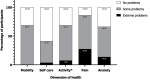
Health state and HQoL among older Malawians: health state responses using the EQ-5D-3L tool showed that pain was the most prevalent (86.3%) health problem among participants, followed by mobility issues (68.8%) and activity (usual activities) restriction (68.8%). Despite this, over half of the participants had no problems performing self-care activities, and none reported extreme problems in the mobility dimension. Two-thirds of the respondents had some form of anxiety or depression (Figure 1), and only two had no problems across all dimensions of health as assessed by the tool (Table 2). Translation of participants’ EQ-5D-3L data to EuroQoL health states revealed thirty-two unique health profiles (combinational summaries of reported status on each dimension) out of the tool’s possible 243. These states were then converted to utility values (Table 2), using the Zimbabwe value set which was developed via the TTO method. Based on this value set, participants who reported a health profile indicative of full health (i.e. Profile 11111- meaning no problems across all dimensions, only two participants in this study) were assigned the highest utility index value of 0.90 (Table 2). Five most prevalent health profiles in this study were 22222 (health state characterised by moderate problems in all EQ-5D-3L dimensions); 11121 (moderate pain and no issues in the rest of the dimensions); 21222 (no problems with self-care activities but moderate problems in all the other dimensions); 22233 (moderate problems in mobility, self-care and usual activities coupled with severe pain and depression); and 11112 (moderate anxiety or depression with no issues in the rest of the dimensions) (Table 2). Overall, the mean health utility score, representing overall HQoL for this population, was 0.6 ± 0.2, which translates to the fact that, assuming 10 years of life left, participants would trade four years of their life for six years of full health rather than continue living in their current state for the whole ten years. In this study, there were no profiles that suggested that any of the participants considered themselves to be in a state worse than dead (i.e. heath state profile having a negative index value).
Six-minute walk distance and factors associated with high HQoL: in this study, the mean 6MWD among the participants was 304.3 ±112.4 metres with a range between 78 and 564 metres. Older males (330.2 ± 135.6 metres) walked longer distances than females (291.2 ± 97.4 metres), although this difference was not statistically significant (p = .1497). There were also no significant differences in walked distance with respect to medical complaint (p = .103). Multiple linear regression analysis found that longer walk distance on the 6MWT was significantly associated with higher HQoL scores (β: 0.09, 95% CI: 0.03 - 0.15; p = .007), which means that for every 100-metre increase in walked distance on 6MWT, HQoL increases by 0.09 units in EuroQoL utility values, holding all other variables constant (Table 3). There were no significant relationships between HQoL and the rest of the variables in this study (Table 3).
This study aimed to understand anthropometric characteristics, functional capacity, and HQoL among community-dwelling older people in Blantyre, Malawi. Out of eighty-five participants recruited in the study, we found that males were taller and had lower BMI scores than females. We further found that the majority presented with musculoskeletal and cardiovascular problems and over two-thirds had elevated blood pressure. On the EQ-5D-3L assessment, pain was the most reported dimension, along with mobility issues and activity restriction. Overall, the mean HQoL score for older Malawians in this study was 0.6 ± 0.2, and longer walk distance on the 6MWT was significantly associated with higher HQoL. Scores on anthropometric characteristics observed in the current study are consistent with reports from diverse African societies. For instance, average BMI lower than 25kg/m2 were reported among older people in Ghana (19.4kg/m2), Tanzania (18.2kg/m2), Ethiopia (20.1kg/m2) and Kenya (21.1kg/m2) [16]. However, consistent with earlier studies in Malawi [17,18], there was a significant difference in BMI with respect to sex in the present study, where males scored lower than females. As BMI is a correlational measure of nutritional status, this likely reflects a continually widening gap in body composition, diet, and physical activity demands between older men and women in Malawi. Musculoskeletal (MSI) and cardiovascular (CVI) impairments topped the list of participants’ complaints in this study (Table 1), highlighting a significant burden among older Malawians. This is consistent with global patterns. Evidence indicates that musculoskeletal disorders such as arthritis, fractures, and myofascial pain account for over half of chronic pain cases among older adults globally and are a leading cause of immobility, falls, and early retirement among older people [19,20].
In Malawi, Ngoie and colleagues reported a census-based, population-level MSI prevalence of 9.5% as of 2021 [21]. However, although specific data on older Malawians are scarce, the prevalence of MSI in this demographic is expected to be higher. It is known that as people age, progressive losses in skeletal muscle mass (sarcopenia) occur and are accompanied by a decrease in strength, flexibility, and reflexes [20]. As this happens, muscle fibres are replaced by connective and adipose tissue, posing adverse effects on motor control and functional performance. Similarly, joints suffer decline in synovial fluid production coupled with thinning of articular cartilage and shortening of ligaments. This exposes joints to considerable wear and tear such that by age 80 most people develop some form of arthrosis [22], further exacerbating pain, functional limitation and fall risk. Over two-thirds of older people in the current study reported most problems in pain, mobility, and activity dimensions of the EQ-5D-3L tool (Figure 1). Allain et al. Reported a 41% incidence of falls among community-dwelling older Malawians in 2014 [8]. Through EQ-5D valuation, the present study found that HQoL for older Malawians who are ageing in place is 0.60 ± 0.20. Compared with other diverse populations, this score is reflective of poorer health states, so much so than age-matched populations in Indonesia (0.89) and the United Kingdom (0.73) [23,24], adults living with breast cancer in Ethiopia (0.8 ± 0.25) [25], and rural miners in Zimbabwe (0.9 ± 0.1) [26]. This may be due to differences in disease risks, health-seeking behaviours and access to healthcare. Indeed, compared with other societies, older Malawians face a huge burden of undernutrition, musculoskeletal disorders and discrimination affecting both physical and mental health [2,8]. Moreover, the shortage of healthcare facilities in rural areas, under-inclusiveness of existing primary health care (PHC) models, and the structural inaccessibility of free healthcare likely push the elderly towards informal health remedies. A lucid detail of strategies for enhancing PHC access for older people in Malawi was outlined by Kwaitana et al. [27].
To our knowledge, this is the first time that health status for older Malawians is expressed in economically weighted utility scores. Therefore, the study sets a foundation for future cross-population comparison. While it is possible that Malawians value health differently than Zimbabweans (as population differences have been observed in the literature [15,23]), our use of the Zimbabwe tariff as a value set close to Malawi was informed by standard practice [28]. The Zimbabwe tariff was developed through a standardized valuation exercise using the TTO technique in a representative sample of the Zimbabwe population [15,29]. In practice, TTO involves asking participants how many years of life they would be willing to trade to avoid a hypothetical impaired health state. (i.e., giving up some years of life in exchange for momentary full health) [24,30]. The mean index value obtained from the valuation exercise represents the population’s overall HQoL. Usually, such exercises are followed by statistical modelling to generate figures which, in combination with other parameters (such as survival estimates and intervention costs), allow calculation of quality-adjusted life years (QALYs) and incremental cost-effectiveness ratio (ICER) for new interventions, aiding decisions in population health planning [31-33]. To date, EQ-5D value sets for Malawi are not available, although studies on psycho- and clinimetric performance of locally adapted versions have reported satisfactory results [34-36], paving the way for population-wide application. In this study, mean 6MWD was positively associated with HQoL, where HQoL increased by 0.09 units (in EuroQoL utility values) for every 100-metre increase in 6MWD. This reflects nearly 0.1 QALYs gained for every year an older person lives in the improved state. To put it in perspective, this is equivalent to ~1 QALY gained for every 10 years of life (QALY = time in years x utility value) and highlights the impact of improved functional tolerance on quality of life.
This makes 6MWD an outcome measure directly correlated with economically weighted indices of quality of life and relevant in the evaluation of interventions targeting functional capacity and wellness in older age. Originally developed in 1982 as a measure of endurance and exercise capacity for individuals with cardiopulmonary pathology based on McGavin’s 12-minute field performance test [37], the 6MWT offers a reliable and widely accepted method for assessing functioning and exercise tolerance among older individuals [38]. This is mainly because of the test’s versatility, allowing assessment of multiple body systems in a single session. For instance, by requiring participants to walk a set distance at moderate-to-high but self-regulated levels of exertion (intensity), the test offers a quick, affordable, and well-tolerated way for examining the integrity of the musculoskeletal system (muscles, joints and bones), temporo-spatial parameters of gait (e.g. Step width, cadence or foot progression angle), and walking independence (motor control, balance and flexibility) in older age. Additionally, the test’s demand for repetitive activity (walking) within controlled time limits provides a physiologically plausible method for measuring cardiorespiratory endurance, making it a suitable outcome measure for both institutionalized and community-dwelling older adults. In two separate studies, peak oxygen uptake (VO2) on 6MWT corresponded with 80% of VO2max and 79% of maximal heart rate (HR max) as obtained on ramp protocol (maximal) cardiopulmonary test (CPET) on treadmill [39,40]. Thus, results of a 6MWT represent multiple physiological measures that collectively reflect the biological state of capacity and ability in older age. Several strategies were employed to standardise assessments used in this study; however, some limitations were encountered. During assessment of height, although participants were encouraged to stand erect, measurements may have been confounded by varying degrees of kyphosis and slouching, which are common in older age. For this reason, height was measured three times and averages were recorded. Furthermore, walking speed on the 6MWT was regulated within limits of safety to prevent falls and may have differed from the maximum achievable by each participant. However, based on ATS guidelines, there is no indication to aim for maximal levels of exertion, as clients are advised to slow down, stop, or rest as needed during the test. Lastly, there was unequal sex distribution in the current study. As such, observed sex differences should be interpreted with caution.
Anthropometric and physiological characteristics of older Malawians reported in this study are consistent with data from diverse African populations. Similarly, musculoskeletal and cardiovascular diseases are a shared global concern. Health-related quality of life for older Malawians who are ageing in place is 0.6±0.2 and is lower than age-matched populations in other countries. Lastly, walk distance on 6MWT is a relevant outcome measure positively associated with economically-weighted indices of HQoL and should be integrated in interventions targeting functional capacity and wellness among older Malawians
What is known about this topic
- Ageing is associated with decline in physiological reserves which is exacerbated by diseases common in older age;
- Majority of older Malawians live in poor conditions, face food insecurity, and are prone to discrimination;
- Scarcity of data on health characteristics of older people in Malawi hinders focused social intervention on ageing.
What this study adds
- Anthropometric characteristics of older Malawians are consistent with data of diverse African populations;
- The utility value representing health-related quality of life for older Malawians who are ageing in place is 0.6±0.2, and lower than age-matched populations in other countries;
- The six-minute walk test is a relevant metric for assessing functional capacity in older age and positively associates with economically-weighted indices of quality of life among older Malawians.
The authors declare no competing interests.
Charles Nyasa, Anthony Mwakikunga, and Enock Chisati: conceptualised the study, collected data and took part in analysis. Yamikani Nangwale: analysed and interpreted the data. Anthony Mwakikunga and Enock Chisati: jointly monitored data quality. Charles Nyasa and Yamikani Nangwale drafted the manuscript. All the authors have read and agreed to the final manuscript.
The authors thank the nurses and physiotherapists of Kalibu Elderly Clinic for assistance with records and guidance on participants’ safety.
Table 1: anthropometric and physiologic characteristics of community dwelling older people in rural Blantyre, Malawi
Table 2: valuation table for self-reported health states showing older Malawians’ health profiles and corresponding health utility values
Table 3: results of multiple linear regression analysis to explore factors associated with high health-related quality of life among older people in Malawi
Figure 1: summary of responses on five dimensions of health status among community dwelling older people in rural Blantyre, Malawi. Note that majority of participants indicated problems in the pain dimension at the time of interviews
- National Statistics Office. 2018 Malawi population census and housing report - Main Report. NSO; Zomba. 2019.
- Nyasa C, Mwakikunga A, Chisati E. Care for older people in Malawi: a situation analysis. Social Innovations Journal. 2019 Aug 29(56). Google Scholar
- Moore E, Chintsanya J, Gowoka P, Chalira E, Kendie J, Chimwaza T et al. Older persons and community care in Malawi: Brief. Family caregiving of older persons in southern Africa programme. University of Malawi. 2024 Oct. Google Scholar
- Government of Malawi. National policy for older persons. GOM; Lilongwe. 2016.
- Hagen K. The Livingstone call for action: a critical analysis, Uganda, Rwanda, Malawi. University of Utrecht. 2009. Google Scholar
- Freeman E. Equitable, sustainable and acceptable long-term care in Malawi? Unpacking the implied universalism of key terms in international ageing policy discourse. Int J Care Caring. 2023 May 1;7(2):287-306. Google Scholar
- Kendall J, Anglewicz P. Living arrangements and health at older ages in rural Malawi. Ageing Soc. 2018 May;38(5):1018-1040. PubMed | Google Scholar
- Allain TJ, Mwambelo M, Mdolo T, Mfune P. Falls and other geriatric syndromes in Blantyre, Malawi: a community survey of older adults. Malawi Med J. 2014 Dec;26(4):105-8. PubMed | Google Scholar
- Fries JF. The theory and practice of active aging. Curr Gerontol Geriatr Res. 2012:2012:420637. PubMed | Google Scholar
- Fries JF, Bruce B, Chakravarty E. Compression of morbidity 1980-2011: A focused review of paradigms and progress. J Aging Res. 2011:2011:261702. PubMed | Google Scholar
- Fries JF. The compression of morbidity. Milbank Q. 1989;67(2):208-32. PubMed | Google Scholar
- Rudnicka E, Napierała P, Podfigurna A, Męczekalski B, Smolarczyk R, Grymowicz M. The World Health Organization (WHO) approach to healthy ageing. Maturitas. 2020 Sep:139:6-11. PubMed | Google Scholar
- Bartlett JE, Kotrlik JW, Higgins CC. Organizational Research: Determining Organizational Research: Determining Appropriate Sample Size in Survey Research Appropriate Sample Size in Survey Research. ITL and PJ. 2001 Jul 12;19(1):43. Google Scholar
- ATS Statement: Guidelines for the Six-Minute Walk Test. Am J Respir Crit Care Med. 2002 Jul 1;166(1):111-7. PubMed | Google Scholar
- Jelsma J, Hansen K, De Weerdt W, Cock P De, Kind P. Population Health Metrics How do Zimbabweans value health states? Popul Health Metr. 2003 Dec 16;1(1):11. PubMed | Google Scholar
- Kimokoti RW, Hamer DH. Nutrition, health, and aging in sub-Saharan Africa. Nutr Rev. 2008 Nov;66(11):611-23. PubMed | Google Scholar
- Chilima DM, Ismail SJ. Nutrition and handgrip strength of older adults in rural Malawi. Public Health Nutr. 2001 Feb;4(1):11-7. PubMed | Google Scholar
- Chilima DM, Ismail SJ. Anthropometric characteristics of older people in rural Malawi. Eur J Clin Nutr. 1998 Sep;52(9):643-9. PubMed | Google Scholar
- Papadakis M, Sapkas G, Papadopoulos EC, Katonis P. Pathophysiology and Biomechanics of the Aging Spine. Open Orthop J. 2011:5:335-42. PubMed | Google Scholar
- Zoico E, Rossi A, Di Francesco V, Sepe A, Olioso D, Pizzini F et al. Adipose tissue infiltration in skeletal muscle of healthy elderly men: Relationships with body composition, insulin resistance, and inflammation at the systemic and tissue level. Journals of Gerontology - Series A Biological Sciences and Medical Sciences. J Gerontol A Biol Sci Med Sci. 2010 Mar;65(3):295-9. PubMed | Google Scholar
- Ngoie LB, Dybvik E, Hallan G, Gjertsen JE, Mkandawire N, Varela C et al. Prevalence, causes and impact of musculoskeletal impairment in Malawi: A national cluster randomized survey. PLoS One. 2021 Jan 6;16(1):e0243536. PubMed | Google Scholar
- Tortora GJ., Derrickson Bryan. Principles of anatomy and physiology. John wiley & sons; 2008 Apr 11. Google Scholar
- Janssen MF, Szende A, Cabases J, Ramos-Goñi JM, Vilagut G, König HH. Population norms for the EQ-5D-3L: a cross-country analysis of population surveys for 20 countries. Eur J Health Econ. 2019 Mar;20(2):205-216 PubMed | Google Scholar
- Dermawan F, Fredrick P, Purba D. Quality of Life Measurement and Its Application in Indonesia. Erasmus University. 2018. Google Scholar
- Sibhat SG, Fenta TG, Sander B, Gebretekle GB. Health-related quality of life and its predictors among patients with breast cancer at Tikur Anbessa Specialized Hospital, Addis Ababa, Ethiopia. Health Qual Life Outcomes. 2019 Nov 5;17(1):165. PubMed | Google Scholar
- Becker J, Bose-O’Reilly S, Shoko D, Singo J, Steckling-Muschack N. Comparing the self-reported health-related quality of life (HRQoL) of artisanal and small-scale gold miners and the urban population in Zimbabwe using the EuroQoL (EQ-5D-3L+C) questionnaire: A cross-sectional study. Health Qual Life Outcomes. 2020 Jul 29;18(1):253. PubMed | Google Scholar
- Kwaitana D, Bates MJ, Msowoya E, van Breevoort D, Mildestvedt T, Meland E et al. Primary health care challenges: insights from older people with multimorbidity in Malawi – a qualitative study. BMC Public Health. 2024 May 29;24(1):1434. PubMed | Google Scholar
- EuroQoL Research Foundation. EQ-5D-3L User Guide: Basic information on how to use the EQ-5D-3L instrument. Rotterdam: EuroQol Group. 2011 Apr;22 . Google Scholar
- Dolan P. Modeling Valuations for EuroQoL Health States. Med Care. 1997 Nov;35(11):1095-108. PubMed | Google Scholar
- Zarate V, Kind P, Valenzuela P, Vignau A, Olivares-Tirado P, Munoz A. Social valuation of EQ-5D health states: The chilean case. Value Health. 2011 Dec;14(8):1135-41. PubMed | Google Scholar
- Santos M, Cintra MACT, Monteiro AL, Santos B, Gusmão-Filho F, Andrade Mv et al. Brazilian valuation of EQ-5D-3L health states. Med Decis Making. 2016 Feb;36(2):253-63. PubMed | Google Scholar
- Prevolnik Rupel V, Srakar A, Rand K. Valuation of EQ-5D-3l health states in Slovenia: VAS based and TTO based Value Sets. Zdr Varst. 2019 Dec 13;59(1):8-17. PubMed | Google Scholar
- Kularatna S, Whitty JA, Johnson NW, Jayasinghe R, Scuffham PA. Valuing EQ-5D health states for Sri Lanka. Qual Life Res. 2015 Jul;24(7):1785-93. PubMed | Google Scholar
- Chokotho L, Mkandawire N, Conway D, Wu HH, Shearer DD, Hallan G et al. Validation and reliability of the Chichewa translation of the EQ-5D quality of life questionnaire in adults with orthopaedic injuries in Malawi. Malawi Med J. 2017 Jun;29(2):84-88. PubMed | Google Scholar
- Ngwira LG, Maheswaran H, Verstraete J, Petrou S, Niessen L, Smith SC. Psychometric performance of the Chichewa versions of the EQ-5D-Y-3L and EQ-5D-Y-5L among healthy and sick children and adolescents in Malawi. J Patient Rep Outcomes. 2023 Mar 9;7(1):22. PubMed | Google Scholar
- Ngwira LG, Jelsma J, Maheswaran H, Kapakasa F, Derrett S, Petrou S et al. Cross-Cultural Adaptation of the Beta EQ-5D-Y-5L Into Chichewa (Malawi).Value Health Reg Issues. 2022 May:29:36-44. PubMed | Google Scholar
- Troosters T, Gosselink R, Decramer M. Six minute walking distance in healthy elderly subjects. Eur Respir J. 1999 Aug;14(2):270-4. PubMed | Google Scholar
- Rikli RE, Jones CJ. The Reliability and Validity of a 6-Minute Walk Test as a Measure of Physical Endurance in Older Adults. J Aging Phys Act. 1998 Oct 1;6(4):363-75. Google Scholar
- Sperandio EF, Arantes RL, Matheus AC, Silva RP, Lauria VT, Romiti M et al. Intensity and physiological responses to the 6-minute walk test in middle-aged and older adults: A comparison with cardiopulmonary exercise testing. Braz J Med Biol Res. 2015 Apr;48(4):349-53. PubMed | Google Scholar
- Kervio G, Carre F, Ville NS. Reliability and Intensity of the Six-Minute Walk Test in Healthy Elderly Subjects. Med Sci Sports Exerc. 2003 Jan;35(1):169-74. PubMed | Google Scholar
Search
This article authors
On Pubmed
On Google Scholar
Citation [Download]
Navigate this article
Similar articles in
Key words
Tables and figures

Article metrics
Recently from the PAMJ



Authors´ services