Clinical characteristics, treatment approaches, and outcomes of ocular adnexal malt lymphoma
Do Huyen Nga, Vu Duc Binh, Tran Quoc Trung, Nguyen Thanh Tung
Corresponding author: Do Huyen Nga, Department of Medical Oncology, Vietnam National Cancer Hospital, Hanoi, Vietnam 
Received: 17 Feb 2026 - Accepted: 05 Jun 2026 - Published: 14 Jul 2026
Domain: Ophthalmology
Keywords: Ocular adnexal tumor, MALT lymphoma, OAMTL, indolent lymphoma
Funding: This work received no specific grant from any funding agency in the public, commercial, or non-profit sectors.
This article is published as part of the supplement Innovations and Challenges in Global Health: A Multidisciplinary Perspective, commissioned by Young Researchers and Elite Club.
©Do Huyen Nga et al. Pan African Medical Journal (ISSN: 1937-8688). This is an Open Access article distributed under the terms of the Creative Commons Attribution International 4.0 License (https://creativecommons.org/licenses/by/4.0/), which permits unrestricted use, distribution, and reproduction in any medium, provided the original work is properly cited.
Cite this article: Do Huyen Nga et al. Clinical characteristics, treatment approaches, and outcomes of ocular adnexal malt lymphoma. Pan African Medical Journal. 2026;54(1):16. [doi: 10.11604/pamj.supp.2026.54.1.51676]
Available online at: https://www.panafrican-med-journal.com//content/series/54/1/16/full
Research 
Clinical characteristics, treatment approaches, and outcomes of ocular adnexal malt lymphoma
Clinical characteristics, treatment approaches, and outcomes of ocular adnexal malt lymphoma
Do Huyen Nga1,&, Vu Duc Binh2, Tran Quoc Trung1,  Nguyen Thanh Tung1
&Corresponding author
Introduction: to evaluate clinical characteristics, treatment patterns, treatment responses, and survival outcomes of patients with ocular adnexal MALT lymphoma treated in Vietnam.
Methods: this single-center retrospective observational study included adult patients with newly diagnosed ocular adnexal MALT lymphoma treated at the Vietnam National Cancer Hospital between January 2019 and December 2024. Treatment strategies comprised watchful waiting, radiotherapy, doxycycline, rituximab monotherapy, or rituximab-based chemoimmunotherapy. Treatment response was assessed according to the Lugano classification. Progression-free survival (PFS) and overall survival (OS) were estimated using the Kaplan-Meier method.
Results: a total of 68 patients were included, with a median age of 60 years and male predominance. Most patients presented with early-stage disease and low MALT International Prognostic Index risk. Initial management consisted of active surveillance in 33.8% of patients and active treatment in 66.2%, most commonly doxycycline or rituximab-based therapy. Among patients receiving rituximab-based combination chemotherapy, interim assessment demonstrated a 100% overall response rate. At the end of treatment, the overall response rate among treated patients was 75.6%, including 37.8% complete responses. After a median follow-up of 32 months, median PFS was not reached, with an estimated 3-year PFS of 85.3% and a 3-year OS of 97%. No statistically significant difference in PFS was observed between patients managed with immediate treatment and those initially observed.
Conclusion: ocular adnexal MALT lymphoma in this Vietnamese cohort demonstrated indolent clinical behaviour, high treatment responsiveness, and excellent survival outcomes. Both active surveillance and active treatment were associated with favourable progression-free and overall survival when appropriately applied. These findings provide region-specific evidence to inform individualised management strategies in Vietnam.

Ocular adnexal mucosa-associated lymphoid tissue (MALT) lymphoma is an indolent B-cell non-Hodgkin lymphoma arising from extranodal marginal zone tissue in structures surrounding, but not within, the globe [1,2]. Under the World Health Organization classification, it is defined as extranodal marginal zone B-cell lymphoma of MALT type and most frequently originates in the conjunctiva, orbit, eyelid, or lacrimal gland [2-5]. Although ocular adnexal lymphomas account for only approximately 1-2% of all non-Hodgkin lymphomas and about 8% of extranodal lymphomas, MALT lymphoma represents the predominant histologic subtype in this region, comprising roughly 35-90% of primary ocular adnexal lymphomas, with most series reporting proportions between 60% and 80% [2,4-6]. It is essential to distinguish primary ocular adnexal MALT lymphoma from secondary ocular involvement by systemic lymphomas, as these entities differ substantially in staging, therapeutic strategy, and prognosis [2,4].
The incidence of ocular adnexal MALT lymphoma has increased over recent decades in population-based studies, likely reflecting improved diagnostic recognition and refined pathologic classification [2,4]. The disease is typically diagnosed in patients in their late 50s to 60s and shows a slight male predominance in many cohorts [1,6-8]. Clinically, approximately 65-90% of patients present with localised Ann Arbour stage I disease, most commonly involving the conjunctiva or orbit, followed by the lacrimal gland and eyelid [2,5,6,9,10]. Typical manifestations include a painless periocular mass, swelling, proptosis, or diplopia, while systemic B symptoms are rare [6,7]. Pathogenetically, ocular adnexal MALT lymphoma is frequently associated with chronic antigenic stimulation, including autoimmune disorders and infectious agents such as Chlamydia psittaci, with marked geographic variation [2,11,12]. Histologically, it is characterised by small neoplastic B cells with marginal zone differentiation, reactive lymphoid follicles, and an immunophenotype consistent with post-germinal centre B-cell origin, accounting for its typically indolent course but persistent risk of relapse [2,4,13].
Management of ocular adnexal MALT lymphoma (OAML) requires a careful balance between achieving durable lymphoma control and preserving vision and long-term quality of life. Radiotherapy (RT) has been the most widely used first-line treatment for localised OAML, with conventional doses of 24-30 Gy (historically up to 40 Gy) producing local control rates of approximately 96-100%, 5-10-year progression-free survival (PFS) of 70-90%, and overall survival (OS) exceeding 90% [10,14-18]. However, late ocular adverse effects, including cataract in 12-40% and dry eye in 8-60% of patients, remain a significant concern, particularly in long-term survivors [16-18]. More recently, ultra-low-dose RT (4 Gy in two fractions) has emerged as an alternative for indolent ocular adnexal lymphomas, demonstrating overall response rates of 88-100%, local control up to 100%, 2-year PFS greater than 85%, and minimal toxicity, with no reported grade ≥3 adverse events [19].
Systemic and eye-sparing approaches are increasingly incorporated into the therapeutic landscape of OAML, particularly for bilateral, orbital, or advanced-stage disease. Rituximab-based chemoimmunotherapy regimens, such as R-CVP or R-CHOP-like protocols, achieve complete remission rates of approximately 85-94%, with 4-5-year PFS of 70-90% and OS approaching 100%, although they are associated with systemic toxicities such as neutropenia [20-22]. Rituximab monotherapy, administered intravenously or intralesionally, has been reported to induce complete remission in up to 100% of patients in small series, with event-free survival comparable to RT and minimal ocular toxicity, making it an attractive eye-preserving option [23,24]. In selected patients with small, accessible lesions, complete surgical excision followed by observation is feasible, and a watchful waiting strategy is acceptable in asymptomatic, localised disease, with 5-year PFS of approximately 60-70% and OS of 95-98%, although careful long-term follow-up is essential due to the risk of local progression [7,8,23,25]. Despite excellent survival, relapses remain frequent, often involving the contralateral orbit or distant extranodal or nodal sites, and histologic transformation has been reported in approximately 3-4% of cases [8,18,22].
Although the existing literature demonstrates favourable long-term outcomes for OAML, most published data originate from East Asian, European, and North American populations, while evidence from Southeast Asia, including Vietnam, is notably limited. The present study therefore aimed to evaluate treatment patterns and outcomes of patients with ocular adnexal MALT lymphoma treated in Vietnam.

Study design: this single-center retrospective observational study evaluated the clinical characteristics, treatment patterns, and outcomes of patients with ocular adnexal mucosa-associated lymphoid tissue lymphoma (OAMTL) treated at a national tertiary oncology centre.
Setting: the study was conducted at Vietnam National Cancer Hospital (K Hospital), Hanoi, Vietnam. All patients diagnosed with OAMTL between January 2019 and December 2024 were eligible for inclusion, and clinical follow-up was performed through June 2025 according to institutional lymphoma management protocols.
Participants: eligible patients were adults aged ≥18 years with histopathologically confirmed extranodal marginal zone B-cell lymphoma of mucosa-associated lymphoid tissue arising from the ocular adnexa (orbit, conjunctiva, eyelid, or lacrimal gland); for patients initially diagnosed at other institutions, pathology specimens were centrally reviewed and confirmed at K Hospital. Patients were excluded if they had severe comorbidities with estimated life expectancy <1 year, alternative indolent ocular adnexal lymphoma histology (e.g., follicular lymphoma or small lymphocytic lymphoma), or insufficient clinical, treatment, or follow-up data.
Variables: the primary outcomes were treatment response, progression-free survival (PFS), and overall survival (OS). Treatment responses were categorised as complete response, partial response, stable disease, or progressive disease according to Lugano classification criteria. Covariates included age, sex, tumour location, disease stage, largest tumour diameter, treatment modality, and prognostic risk according to the MALT International Prognostic Index, defined by age (<70 vs ≥70 years), lactate dehydrogenase level (normal vs elevated), and stage (I-II vs III-IV).
Data sources and measurement: clinical and paraclinical data were retrospectively extracted from medical records at diagnosis and follow-up visits. Baseline evaluation included medical history, physical examination, and assessment of ocular symptoms. Laboratory investigations comprised complete blood count, liver and renal function tests, serum lactate dehydrogenase, and bone marrow aspiration. Disease staging and treatment response were assessed clinically and by imaging with computed tomography, magnetic resonance imaging, or positron emission tomography/computed tomography, the latter preferentially used when histologic transformation was suspected. Treatment strategies were determined by a multidisciplinary tumor board based on disease stage, tumor burden, symptoms, progression, and patient performance status and included watchful waiting for minimally symptomatic low-burden disease, involved-site radiotherapy (24-36 Gy in 1.8-2.0 Gy fractions) for localized stage IE disease, doxycycline 100 mg twice daily for 2-3 months, and systemic therapy with rituximab alone or rituximab-based chemoimmunotherapy (CVP, CHOP, or bendamustine) for bilateral, advanced-stage, or unfavorable disease. Follow-up assessments were scheduled according to treatment modality: during systemic therapy, at one month after radiotherapy, every two months for doxycycline therapy, and every three to six months for surveillance.
Bias: selection bias was minimised by including all consecutive eligible patients during the study period with centralised pathology confirmation, and information bias was reduced through standardised institutional staging procedures, treatment protocols, and imaging-based response assessment. Nevertheless, residual bias related to the retrospective single-centre design and heterogeneity of treatment allocation cannot be excluded.
Study size: the study included the entire cohort of eligible patients with ocular adnexal mucosa-associated lymphoid tissue lymphoma treated at K Hospital between 2019 and 2024, comprising a total of 68 patients.
Quantitative variables: continuous variables, including age and laboratory parameters, were summarised using medians and ranges, whereas categorical variables, including stage, treatment modality, and response category, were expressed as frequencies and percentages. Survival time variables included progression-free survival and overall survival, calculated in months from the date of diagnosis.
Statistical methods: treatment efficacy was evaluated using the overall response rate. Progression-free survival was defined as the interval from diagnosis to disease progression, relapse, or death from any cause, and overall survival as the interval from diagnosis to death from any cause. Survival curves were estimated using the Kaplan-Meier method, and comparisons between treatment strategies were performed using the log-rank test. Categorical variables were compared using the chi-square test or Fisher's exact test, as appropriate. A two-sided p-value <0.05 was considered statistically significant. All statistical analyses were conducted using SPSS Statistics version 23.0 (IBM Corp., Armonk, NY, USA).
Ethical consideration statement: the study was approved by the Institutional Ethics Review Board of Vietnam National Cancer Hospital (Decision No. 3374; 22 November 2024). All patient data were handled confidentially in accordance with the Declaration of Helsinki, and written informed consent was obtained from all participants. No procedures beyond standard clinical care were performed, and all data collection complied with institutional and national regulations governing biomedical research involving human subjects.
Demographic characteristics: the median age at diagnosis was 60 years (range, 19-82), with a male predominance (67.6%), and most patients had good performance status (ECOG 0-1, 91.2%), while B symptoms were uncommon (8.8%). Bilateral ocular involvement was most frequent (36.7%), the median tumour size was 30 mm, and most tumours measured 20-40 mm. Elevated serum LDH and bone marrow involvement were rare (8.9% and 2.9%, respectively), and most patients presented with early-stage disease (Lugano stage I, 83.9%) and low MALT-IPI risk (73.5%). Initial management included active surveillance in 33.8% of patients and active treatment in 66.2%, most commonly doxycycline (26.7%) or rituximab-based therapy, with radiotherapy used infrequently (6.7%) (Table 1).
Descriptive statistics: among the 22 patients treated with rituximab-based combination chemotherapy (rituximab-bendamustine, R-CVP, or R-CHOP), interim response assessment demonstrated an overall response rate (ORR) of 100% across all regimens (Table 2). Complete response (CR) rates differed by regimen, with higher CR rates observed for rituximab-bendamustine (63.6%) and R-CHOP (66.7%), while R-CVP achieved a CR in 25% of patients, with the remaining 75% achieving partial response (PR). No patients experienced stable disease (SD) or progressive disease (PD) at interim evaluation. End-of-treatment (EOT) responses for all 45 treated patients are presented in Table 3. Overall, treatment response was achieved in 34 patients (76%), including 17 patients (38%) with CR and 17 patients (38%) with PR. The highest CR rates were observed in the rituximab-bendamustine (72.7%) and R-CHOP (66.7%) groups. The R-CVP regimen maintained a 100% ORR but resulted in a lower CR rate (25%), with most patients remaining in PR at EOT. More modest efficacy was observed with single-agent rituximab (ORR 50%, CR 25%), doxycycline (ORR 50%, CR 25%), and radiotherapy (ORR 67%, CR 0%), with a substantial proportion of patients achieving SD. No patient experienced PD as the best response to first-line therapy.
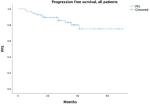
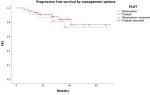
Survival outcomes: after a median follow-up of 32 ± 15 months (range, 5-70), progression-free survival (PFS) for the entire cohort is shown in Figure 1. Median PFS was not reached. The estimated 3-year PFS rate was 85.3%. During follow-up, two deaths were recorded, resulting in a 3-year overall survival (OS) rate of 97%. When analysed according to initial management strategy (Figure 2), patients who received immediate treatment showed a numerically longer estimated PFS compared with those initially managed with observation (59.6 months vs. 55.5 months), although this difference did not reach statistical significance (log-rank p = 0.574). Clinically, disease progression during follow-up was documented in 4 of 23 patients (17.4%) managed with watchful waiting.
In the present study, treatment response and survival outcomes of patients with ocular adnexal mucosa-associated lymphoid tissue lymphoma were favourable and broadly consistent with the indolent nature of this disease. Rituximab-based combination chemotherapy was associated with excellent early efficacy, as a 100% overall response rate was observed at interim assessment across all regimens, and no cases of primary refractory disease were identified. At the end of treatment, more than three-quarters of treated patients achieved an objective response, and progression-free and overall survival rates at 3 years remained high, supporting the effectiveness of contemporary management strategies in routine clinical practice.
The high response rates observed with rituximab-based combination chemotherapy in this cohort are in line with previously published data. Prior studies have reported complete response rates of approximately 85-94% and 4-5-year progression-free survival rates of 70-90% with chemoimmunotherapy regimens such as R-CVP and R-CHOP-like protocols, with overall survival approaching 100% [20-22,26]. In the current series, rituximab-bendamustine and R-CHOP were associated with higher complete response rates compared with R-CVP, a finding that may reflect differences in cytotoxic intensity and patient selection. Nevertheless, all rituximab-based regimens achieved universal disease control at interim evaluation, underscoring the high chemosensitivity of ocular adnexal MALT lymphoma, particularly in patients with bilateral, orbital, or more extensive disease.
When compared with other treatment modalities, systemic therapy demonstrated higher complete response rates than single-agent rituximab, doxycycline, or radiotherapy in this cohort. Radiotherapy has historically been considered the standard first-line treatment for localised ocular adnexal MALT lymphoma, with local control rates of approximately 96-100%, long-term progression-free survival of 70-90%, and overall survival exceeding 90% [10,14-16,18]. However, concerns regarding late ocular toxicities, including cataract and dry eye, which have been reported in 12-40% and 8-60% of patients, respectively, may limit its use in some settings [15-17]. The relatively low utilisation of radiotherapy in the present study likely reflects such considerations, as well as institutional preferences and patient-related factors. The comparatively modest radiotherapy response observed in this cohort should be interpreted cautiously, as only three patients received radiotherapy, substantially limiting the reliability and generalizability of response estimates. Differences in patient selection, disease characteristics, and treatment intent may also have contributed to outcomes that appeared lower than those reported in larger international series. Similarly, the modest response rates observed with doxycycline are consistent with prior reports demonstrating variable efficacy of antibiotic therapy targeting Chlamydia psittaci, which appears to be highly dependent on geographic prevalence [6,17].
Survival outcomes in this cohort were highly favourable, with the median progression-free survival not reached and a 3-year progression-free survival rate of 85.3%, alongside a 3-year overall survival rate of 97%. These findings are comparable to international series reporting 5-10-year overall survival rates exceeding 90-95% regardless of treatment strategy [8,10,15-17]. Although a numerically longer progression-free survival was observed among patients who received immediate treatment compared with those managed initially with watchful waiting, this difference was not statistically significant. This observation is consistent with existing evidence supporting watchful waiting as an acceptable strategy in selected asymptomatic patients with localised disease, in whom 5-year progression-free survival rates of approximately 60-70% and overall survival rates of 95-98% have been reported [7,8,23,25]. Importantly, disease progression during observation occurred in a minority of patients and did not translate into inferior overall survival during the available follow-up.
The findings of this study support an individualised management approach for ocular adnexal MALT lymphoma, in which treatment selection is guided by disease stage, symptom severity, and patient preference. Active surveillance may be considered an appropriate strategy for selected low-risk, asymptomatic patients, while rituximab-based systemic therapy represents an effective therapeutic option with manageable toxicity profiles reported in previous studies, particularly in settings where radiotherapy is not favoured. These results provide region-specific evidence that may assist multidisciplinary teams in optimising management strategies in similar clinical contexts.
Several limitations should be acknowledged. First, the retrospective single-center design introduces potential selection and information bias and may limit the external generalizability of the findings. Second, the relatively small sample size, particularly within individual treatment subgroups such as radiotherapy, restricted the statistical power for subgroup comparisons and may have influenced the precision of treatment outcome estimates. Treatment allocation was not randomised and was influenced by physician judgment and patient characteristics. Although follow-up duration was sufficient to evaluate early and intermediate outcomes, longer observation is required to fully assess late relapses characteristic of indolent lymphomas. In addition, treatment-related toxicities were not systematically captured, and detailed relapse patterns, including local versus distant recurrence, were not comprehensively analysed because of limitations inherent to retrospective data collection. Comprehensive evaluation of quality-of-life outcomes was also limited by the retrospective nature of the study.
In conclusion, ocular adnexal mucosa-associated lymphoid tissue lymphoma in this Vietnamese cohort was characterised by indolent clinical behaviour, high treatment responsiveness, and excellent survival outcomes. Both active surveillance and active treatment strategies were associated with favourable progression-free and overall survival when appropriately applied. Rituximab-based therapies were shown to be particularly effective, while radiotherapy was selectively utilised. However, interpretation of treatment-specific outcomes should be made cautiously because of the retrospective single-centre design and limited sample size. These findings underscore the importance of individualised treatment strategies and contribute valuable regional data to the existing international literature.
What is known about this topic
- Ocular adnexal MALT lymphoma is an indolent extranodal marginal zone lymphoma that most commonly presents with localized early-stage disease and generally demonstrates high responsiveness to radiotherapy or rituximab-based therapy, with long-term overall survival exceeding 90% in most international series;
- Management strategies for ocular adnexal MALT lymphoma range from watchful waiting in asymptomatic localised disease to radiotherapy or systemic immunochemotherapy in bilateral or advanced disease, but treatment selection must balance lymphoma control with preservation of ocular function and quality of life.
What this study adds
- This Vietnamese cohort confirms that ocular adnexal MALT lymphoma demonstrates excellent treatment responsiveness and survival outcomes in routine clinical practice, with a 3-year progression-free survival of 85.3% and overall survival of 97%.
- Both active surveillance and immediate treatment strategies were associated with comparable progression-free survival, supporting individualised management and the feasibility of watchful waiting in selected patients in Southeast Asian settings where radiotherapy use may be limited;
The authors declare no competing interests.
Do Huyen Nga: study conceptualization, design, data collection, interpretation of results, and manuscript drafting. Vu Duc Binh: clinical management input, data interpretation, and critical manuscript revision. Tran Quoc Trung: data acquisition, statistical analysis, and manuscript editing. Nguyen Thanh Tung: data verification, literature review, and manuscript revision. All authors read and approved the final manuscript.
The authors thank the clinicians and nursing staff of the Haematology and Oncology departments at Vietnam National Cancer Hospital for their support in patient care and data collection.
Table 1: characteristics of patients with ocular adnexal MALT lymphoma
Table 2: interim response to rituximab-based combination chemotherapy (n = 22)
Table 3: end-of-treatment response by treatment modality (n = 45)
Figure 1: progression free survival of all patients
Figure 2: progression free survival by management option
- Thamgrang T, Prayongratana K, Norasetthada L, Rattanathammethee T, Lekhakula A, Julamanee J et al. Epidemiology and Prognostic Index of Ocular Adnexal Extranodal Marginal Zone Lymphoma of Mucosa-Associated Lymphoid Tissue (MALT) in Thailand: Results from the Thai Lymphoma Study Group (TLSG). Blood. 2022 2022-11-15. Google Scholar
- Johansson P, Eckstein A, Küppers R. The Biology of Ocular Adnexal Marginal Zone Lymphomas. Cancers (Basel). 2022 Feb 28;14(5):1264. PubMed | Google Scholar
- Uno T, Isobe K, Shikama N, Nishikawa A, Oguchi M, Ueno N et al. Radiotherapy for extranodal, marginal zone, B-cell lymphoma of mucosa-associated lymphoid tissue originating in the ocular adnexa. Cancer. 2003 Aug 15;98(4):865-71. PubMed | Google Scholar
- Stefanovic A, Lossos I. Extranodal marginal zone lymphoma of the ocular adnexa. Blood. 2009 Jul 16;114(3):501-10. PubMed | Google Scholar
- Bayraktar S, Bayraktar U, Stefanovic A, Lossos I. Primary ocular adnexal mucosa-associated lymphoid tissue lymphoma (MALT): single institution experience in a large cohort of patients. Br J Haematol. 2011 Jan;152(1):72-80. PubMed | Google Scholar
- Kiesewetter B, Lukas J, Kuchar A, Mayerhoefer M, Streubel B, Lagler H et al. Clinical Features, Treatment and Outcome of Mucosa-Associated Lymphoid Tissue (MALT) Lymphoma of the Ocular Adnexa: Single Center Experience of 60 Patients. PLoS One. 2014 Jul 31;9(7):e104004. PubMed | Google Scholar
- Liang Y, Fu R-Y, Liu X, Liu X-D, Piao Y, Jian M et al. Long-term survival outcomes of patients with primary ocular adnexal MALT lymphoma: A large single-center cohort study. Cancer Med. 2023 Feb;12(3):2514-2523. PubMed | Google Scholar
- Yoshida K, Iwaki N, Yamauchi N, Koba Y, Shirouchi Y, Ishihara Y et al. Clinical Features and Outcomes of Localized Ocular Adnexal Mucosa-Associated Lymphoid Tissue Lymphoma: A Dual-Center Retrospective Observational Study with a Long-Term Follow-up. Blood. 2024 2024-11-05. Google Scholar
- Chae H, Suh C, Yoon D, Hong J, Park C-S, Huh J et al. Limited Role of Workup Including PET-CT, Esophagogastroduodenoscopy and Bone Marrow Biopsy in Staging of Ocular Extranodal Marginal Zone Lymphoma of Mucosa-Associated Lymphoid Tissue (MALT) Type. Blood. 2016 2016-12-02;128:2988-9. Google Scholar
- Desai A, Joag M, Lekakis L, Chapman J, Vega F, Tibshirani R et al. Long-term course of patients with primary ocular adnexal MALT lymphoma: a large single-institution cohort study. Blood. 2017 Jan 19;129(3):324-332. PubMed | Google Scholar
- Ferreri A, Dolcetti R, Du M, Doglioni C, Resti A, Politi L et al. Ocular adnexal MALT lymphoma: an intriguing model for antigen-driven lymphomagenesis and microbial-targeted therapy. Ann Oncol. 2008 May;19(5):835-46. PubMed | Google Scholar
- Go H, Kim JE, Kim Y, Chung HK, Khwarg S, Kim C et al. Ocular adnexal IgG4-related disease: comparative analysis with mucosa-associated lymphoid tissue lymphoma and other chronic inflammatory conditions. Histopathology. 2012 Jan;60(2):296-312. PubMed | Google Scholar
- Charlotte F, Doghmi K, Cassoux N, Ye H, Du M, Kujas M et al. Ocular adnexal marginal zone B cell lymphoma: a clinical and pathologic study of 23 cases. Virchows Arch. 2006 Apr;448(4):506-16. PubMed | Google Scholar
- Ejima Y, Sasaki R, Okamoto Y, Maruta T, Azumi A, Hayashi Y et al. Ocular adnexal mucosa-associated lymphoid tissue lymphoma treated with radiotherapy. Radiother Oncol. 2006 Jan;78(1):6-9. PubMed | Google Scholar
- Hashimoto N, Sasaki R, Nishimura H, Yoshida K-I, Miyawaki D, Nakayama M et al. Long-term outcome and patterns of failure in primary ocular adnexal mucosa-associated lymphoid tissue lymphoma treated with radiotherapy. Int J Radiat Oncol Biol Phys. 2012 Mar 15;82(4):1509-14. PubMed | Google Scholar
- Harada K, Murakami N, Kitaguchi M, Sekii S, Takahashi K, Yoshio K et al. Localized ocular adnexal mucosa-associated lymphoid tissue lymphoma treated with radiation therapy: a long-term outcome in 86 patients with 104 treated eyes. Int J Radiat Oncol Biol Phys. 2014 Mar 1;88(3):650-4. PubMed | Google Scholar
- Yen M, Bilyk J, Wladis E, Bradley E, Mawn L. Treatments for Ocular Adnexal Lymphoma: A Report by the American Academy of Ophthalmology. Ophthalmology. 2018 Jan;125(1):127-136. PubMed | Google Scholar
- Taguchi S, Sasaki R, Yoshioka Y, Mishima Y, Nishimura N, Yokoyama M et al. Prognosis And Patterns Of Relapse After Radiotherapy For Localized Ocular Adnexal Marginal Zone Lymphoma Of Mucosa-Associated Lymphoid Tissue (MALT Lymphoma). International Journal of Radiation Oncology, Biology, Physics. 2020 Nov 1;108(3):e756. Google Scholar
- Grujić M, Volchenkov S, Akhmetali A, Radojević MŽ, Milosavljevic N, Janković K et al. Clinical Outcomes and Safety of Ultra-Low-Dose Radiotherapy for Ocular Adnexal Lymphoma: A Systematic Review. Cancers (Basel). 2025 Aug 29;17(17):2845. PubMed | Google Scholar
- Kim S-Y, Yang S-W, Lee W, Yang J-W, Oh S, Ahn H et al. Frontline treatment with chemoimmunotherapy for limited-stage ocular adnexal MALT lymphoma with adverse factors: a phase II study. Oncotarget. 2017 Aug 2;8(40):68583-68590. PubMed | Google Scholar
- Jeon Y, Yang H, Choi B-O, Jung S, Park K-S, O JH et al. Comparison of Selection and Long-term Clinical Outcomes Between Chemotherapy and Radiotherapy as Primary Therapeutic Modality for Ocular Adnexal MALT Lymphoma. EClinicalMedicine. 2018 Oct 17;4-5:32-42. PubMed | Google Scholar
- Kim S-Y, Lee W, Oh S, Yang D-H, Kim H, Park S et al. Relapse in patients with limited-stage ocular adnexal lymphoma treated by chemoimmunotherapy: Extended follow-up of a phase 2 study. Cancer Med. 2022 Jul;11(14):2817-2823. PubMed | Google Scholar
- Mizuhara K, Kobayashi T, Nakao M, Takahashi R, Kaneko H, Shimura K et al. Watchful waiting is an acceptable treatment option for asymptomatic primary ocular adnexal mucosa-associated lymphoid tissue lymphoma: A retrospective study. Cancer Med. 2023 Feb;12(3):3134-3144. PubMed | Google Scholar
- Liu Y, Gao Y, Jin L, Li Q, Wang X, Wu Y et al. Safety and efficacy of intralesional rituximab injection versus involved site radiation therapy in primary ocular adnexal MALT lymphoma: study protocol for a multicentre randomised controlled trial. BMJ Open. 2024 Nov 27;14(11):e084904. PubMed | Google Scholar
- Zhao C, Yang S, Zhou Y, Shi J. Progression-Free Survival Improvement of Localized Ocular Adnexal MALT Lymphoma Patients with Residual Lesions: Comparative Outcome of Postoperative Treatment Versus Watchful Waiting. Blood. 2024 Nov 5;144:6323. Google Scholar
- Ma WL, Yao M, Liao SL, Tang JL, Wang YC, Kuo SH et al. Chemotherapy alone is an alternative treatment in treating localized primary ocular adnexal lymphomas. Oncotarget. 2017 Jun 15;8(46):81329-81342. PubMed | Google Scholar
Search
This article authors
On Pubmed
On Google Scholar
Citation [Download]
Navigate this article
Similar articles in
Key words
Tables and figures

This supplement
Article metrics
Map loading delayed...
Recently from the PAMJ




Authors´ services