
AVAREF: a gamechanger for vaccine and medicine regulatory harmonization in Africa and beyond
Bartholomew Dicky Akanmori, Kwasi Nyarko, Diadié Maïga, Charles Shey Wiysonge, Chinwe Iwu-Jaja
Corresponding author: Chinwe Iwu-Jaja, Vaccine Preventable Diseases Program, World Health Organization Regional Office for Africa, Brazzaville, Congo 
Received: 25 Apr 2025 - Accepted: 07 May 2025 - Published: 28 Dec 2025
Domain: Global health,Vaccinology
Keywords: African Vaccine Regulatory Forum, regulatory harmonization, National Regulatory Authorities, Ethics Committees, capacity building, regulatory system strengthening, research and development, Africa
Funding: This work received no specific grant from any funding agency in the public, commercial, or non-profit sectors.
This article is published as part of the supplement The African Vaccine Regulatory Forum (AVAREF): a model for advancing innovation and achieving continent-wide regulatory harmonization through partnerships and collaboration, commissioned by World Health Organization Regional Office for Africa.
©Bartholomew Dicky Akanmori et al. Pan African Medical Journal (ISSN: 1937-8688). This is an Open Access article distributed under the terms of the Creative Commons Attribution International 4.0 License (https://creativecommons.org/licenses/by/4.0/), which permits unrestricted use, distribution, and reproduction in any medium, provided the original work is properly cited.
Cite this article: Bartholomew Dicky Akanmori et al. AVAREF: a gamechanger for vaccine and medicine regulatory harmonization in Africa and beyond. Pan African Medical Journal. 2025;52(2):6. [doi: 10.11604/pamj.supp.2025.52.2.47729]
Available online at: https://www.panafrican-med-journal.com//content/series/52/2/6/full
Essay 
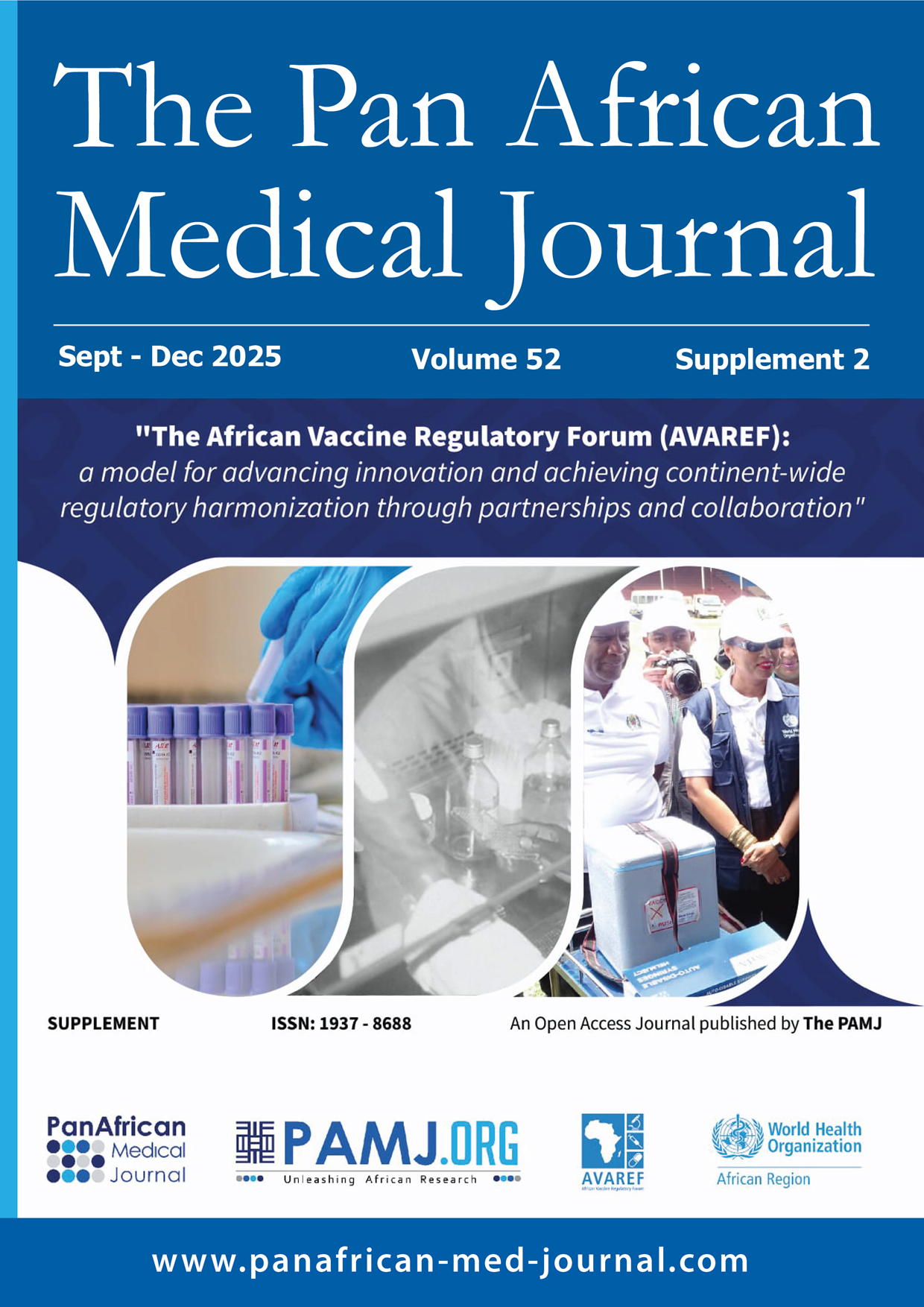
AVAREF: a gamechanger for vaccine and medicine regulatory harmonization in Africa and beyond
AVAREF: a gamechanger for vaccine and medicine regulatory harmonization in Africa and beyond
 Bartholomew Dicky Akanmori1, Kwasi Nyarko1, Diadié Maïga2, Charles Shey Wiysonge1, Chinwe Iwu-Jaja1,&
&Corresponding author
The African Vaccine Regulatory Forum (AVAREF), established by WHO in 2006, has significantly enhanced regulatory harmonization and capacity building for national regulatory authorities and ethics committees across Africa. Through partnerships, capacity building (training, mentorship, and information sharing), and the development of common technical guidance documents, AVAREF has facilitated the successful clinical development and regulatory approval of vaccines against malaria, meningitis, pneumonia, Ebola, COVID-19, etc. all priority diseases of the region. This article explores AVAREF's unique approach to harmonization, starting from a historical standpoint, which focuses on consensus-building and collaboration. We also outlined some successes of the AVAREF model in reducing disease burden and averting millions of deaths in Africa, highlighting its potential for adaptation to improve access to quality medical products and achieve global health goals.

About AVAREF and African Regulatory Systems
Research and development of medical products for public health requires regulatory oversight to ensure that they meet the appropriate international standards, safeguarding the safety of research participants and the integrity of research. Thus, the products are evaluated for their safety, quality, and efficacy so that their benefits outweigh risks for use. Access to affordable, safe, effective, and high-quality medical products such as vaccines, medicines, biotherapeutics, pharmaceuticals, and other advanced biologicals are of paramount importance for the prevention, control, and elimination of diseases in Africa [1]. The regulatory oversight functions in most countries reside primarily in national regulatory authorities (NRAs). However, ethics committees (ECs) or institutional review boards (IRBs) also contribute to clinical evaluations of products and interventions. It is also noteworthy that in some countries, the regulatory decisions are made entirely by ECs [2].
In Africa, NRAs vary in their capacities, standards of reviews, guidelines, and decision-making processes [3]. For several years, it has been argued that African countries lack the full regulatory capacity, independence, and resources to carry out their functions. Stakeholders have specifically identified the prolonged timelines for assessment and authorization of clinical trials and registration of products in Africa [4] as challenges. The ECs and IRBs have also often been considered weak in some institutions and countries. Thus, capacity building for NRAs and ECs has often been cited as a prerequisite for the attraction of product developers for health in Africa. It is within this context that the African Vaccine Regulatory Forum (AVAREF) was established by the World Health Organization (WHO) in 2006, working with multiple partners and stakeholders to address this critical part in the product development cycle [3,5].
The choice of an appropriate strategy and framework for strengthening NRAs and ECs in Africa was a network that would promote convergence and regulatory harmonization across the continent, while at the same time ensuring adherence to reasonably shorter timelines for decision-making. What began in 2006 as an informal network of highly motivated and enthusiastic NRAs and ECs in 19 countries in Africa would go a long way to become highly successful [5]. The outcome led to the clinical development and regulatory approvals of several vaccines, which have made a significant impact in reducing disease burden on the continent [6-12]. AVAREF has therefore become a globally recognized brand that epitomizes excellence in regulatory harmonization in Africa. The present manuscript explores why regulatory harmonization is so important to achieving global health goals and why AVAREF has been so successful in this area. The article also outlines AVAREF´s unique approach to harmonization, which focuses on cultivating partnerships and collaborations rather than through treaties and legal frameworks. Finally, it shares what AVAREF has accomplished from leading by consensus and discusses the potential for the AVAREF model to be adapted for use in other regions of the world to improve access to quality, priority medical products.
Sources of data on AVAREF activities (2007-2022)
The African Vaccine Regulatory Forum is a network comprising NRAs and ECs from all over Africa. It started with 21 countries that were targeted for clinical trials and consistently participated in its annual meetings. Data is reported on these initial 21 countries (Botswana, Burkina Faso, Cameroon, Cote d´Ivoire, DRC, Ethiopia, Gabon, Gambia, Ghana, Kenya, Malawi, Mali, Mozambique, Nigeria, Senegal, Sierra Leone, South Africa, Tanzania, Uganda, Zambia, Zimbabwe) and subsequently all the countries of the African continent. For convenience, data for some selected countries (Ghana, Nigeria, Kenya, South Africa, and Senegal), which have been involved in regulatory harmonization by AVAREF and demonstrated rapid progress in attaining the highest level of regulatory maturity and output, will be used to further show the success of the network. Working with the Boston Consulting Group (BCG), round tables (focus group discussions) were held in all the countries. Desktop reviews and surveys were conducted, the results of which are also included. Reports of workshops, joint reviews, and other training activities conducted as part of AVAREF regulatory harmonization and facilitated by WHO and other experts were used.
At annual meetings of AVAREF between 2006 and 2022, training on review of clinical trial applications (CTAs) was held for NRAs and ECs. Experts came from the European Medicines Agency (EMA), Health Canada, the Center for Biologics Evaluation and Research (CBER) at the United States Food and Drug Administration (US FDA), Paul Ehrlich Institut, and academic institutions. Some sessions of the AVAREF meetings were used for regulatory consultations between African NRAs and NRAs from Europe and North America. There were also specific workshops that covered other areas of training for the regulators. During AVAREF meetings, joint reviews of CTAs were conducted, which led to products that were licensed, prequalified, and introduced across the continent. Notable among these are the malaria vaccine RTS, S/ASO1E, the conjugate meningitis A vaccine, two vaccines against Ebola, and several COVID-19 vaccines. Several guidelines and templates for the submission and review of CTAs were developed and are in use in almost all countries. Other guidelines on Good Clinical Practice (GCP) inspections of trial sites were also developed. These guidelines are available on the AVAREF website. Several key recommendations were made and have been implemented by several countries.
From 2006, timelines for review and clearance of CTAs by NRAs and ECs were collected, analyzed, and shared with the countries. As a result, countries were motivated to reduce the timelines for CTA reviews in compliance with the different timelines agreed for different types of public health priority diseases (regular, expedited, and emergency). Regulatory harmonization was promoted from the initial 21 countries to the Regional Economic Communities (RECs) of the African Union. Thus, most countries are using similar templates and processes for clinical trial regulation and oversight.
Chronicle of achievements of AVAREF
Table 1 highlights the priority vaccines that were successfully developed through clinical trials, WHO prequalification (PQ), and NRA registration. It also signifies the important role of harmonization through AVAREF (Table 1). A key metric of AVAREF's impact has been the significant reduction in timelines for review and approval of clinical trial applications and product registrations. Table 2 and Table 3 present the consolidated timelines for AVAREF joint reviews across different products and periods, 2006-2018 and 2020-2022, respectively, demonstrating the efficiency gains achieved through regulatory harmonization (Table 2 and Table 3). The present manuscript presents data confirming the success of AVAREF as a regulatory and ethics harmonization platform, which has produced tangible results in the form of vaccines against priority public health diseases on the African continent. This success story of AVAREF has been told using historical as well as newly collected and analyzed data. The findings have also been very consistent with previous publications, which highlight the success of the network [2,13-16].
Factors contributing to AVAREF´s success
The specific areas in which this regulatory harmonization initiative began nearly 20 years ago are standardized common ethics and regulatory practices that match WHO and international norms and standards. The result is the successful development through clinical trials and regulatory approvals of key vaccines of public health importance, which have already been highlighted. The vaccines range from RTS, S against childhood malaria, conjugate vaccines against meningitis due to Neisseria meningitidis and Streptococcus pneumoniae, vaccines against Ebola Virus Disease, rotavirus diarrhoea, and cholera, to cervical cancer. The impact of the use of these vaccines has been the reduction in disease burden and millions of deaths averted on the continent.
In the present article, we argue that this success can be attributed to the initial informal nature of the network, not requiring a binding treaty, high motivation and enthusiasm of ethics committees and regulators and the commitment of stronger regulatory authorities (US FDA, Medicines and Healthcare products Regulatory Agency of the United Kingdom [MHRA], EMA and Paul Ehrlich Institut). The strong and long partnership with the BMGF made a significant contribution to the success of AVAREF, through expertise and reliable funding. Other stakeholders, including the pharmaceutical industries, have also contributed to making AVAREF a global success [17]. The governance model of AVAREF, the Pan African Clinical Trial Alliance (PACTA), was developed in close collaboration with the International Federation of Pharmaceutical Manufacturers and Associations (IFPMA). Stakeholders in the Economic Community of West African States (ECOWAS) Medicines Regulatory Harmonization Initiative have admitted the benefits of this network to their product development efforts [18]. Given that all the ECOWAS member states are also members of AVAREF and its statutory bodies (the technical coordinating committee, the steering committee, and the Assembly), the capacity built over the years through AVAREF has been indirectly recognized by the relevant national stakeholders. This is the case with the other regional regulatory harmonization programs of the African Union, i.e., the East African Community (EAC), the Southern African Development Community (SADC), the Intergovernmental Authority on Development (IGAD), and the Economic Community of Central African States (ECCAS). Thus, AVAREF has further facilitated regulatory harmonization and capacity building within the economic communities of Africa.
Lessons for regulatory harmonization
The advantages of the informal nature of AVAREF meant that experts from different countries could challenge each other while sharing their experiences and thereby raising the bar and ensuring overall capacity was firmly built by regulators and ethics committees. The network, at all its meetings and training sessions, gave regulators from the African region and developed countries the opportunity to share confidential information among them, learning to overcome obstacles to the review of complex products and clinical trial designs. Progressively over the years since the establishment of AVAREF, ethics and regulatory capacity have been reflected in the considerable growth of staff strength and expertise. However, it is important to point out that not all of this capacity growth can be directly attributed to AVAREF. Nonetheless, AVAREF has succeeded in highlighting the need to improve staff strength and provide additional expertise, especially in biologics evaluations of both CTAs and dossiers [13].
It is important to point out that the development of common technical guidance documents and standard operating procedures by the network members and their consistent use in ethics and regulatory work in different countries enhanced harmonization without the need for large formal meetings and long discussions required under treaties and other formal and legal entities. The additional value derived from the AVAREF technical guidance documents is that countries can freely modify them to meet their own special or unique situations, thus adding an element of flexibility. Slow implementation is not threatened by sanctions, allowing countries with weaker institutions to gradually improve their capacities and still belong to AVAREF. The arrangement just described enabled countries which were receiving very few CTAs to build systems gradually in readiness to embrace the increase in clinical trials, while at the same time, countries such as Tanzania, South Africa, Kenya, and Ghana, which were already receiving several CTAs annually, rapidly implemented these guidance documents and templates [19]. Thus, it is not surprising that countries such as Ghana, Tanzania, and Nigeria were among the first to attain regulatory maturity level 3 based on the WHO assessment. The perennial issue of unreasonably long periods taken to review and clear clinical trial applications was confronted by AVAREF, and as the data have demonstrated, significant progress has been made in shortening these timelines, highlighting another area of success of AVAREF.

Given the success of this network based on consensus building through engagement of all stakeholders, the AVAREF model remains an attractive mechanism available to other WHO regions and parts of the world. Consensus-building across treaties and regional blocs can lead to the rapid achievement of results and make an impact on public health. By documenting the AVAREF model, other ethics and regulatory harmonization initiatives can rely on its positive aspects to establish or improve their initiatives in regulatory harmonization. The AVAREF consensus-building has played a critical role in addressing the Ebola epidemics and the COVID-19 pandemic. During such public health emergencies, quick solidarity and consensus-building can provide remarkable success, as demonstrated by AVAREF.
All the authors declare no competing interests.
Bartholomew Dicky Akanmori conceptualized the study and wrote the first draft; all authors made critical contributions to subsequent versions; Chinwe Iwu-Jaja finalized and submitted the manuscript, managing all aspects of the submission. All authors have read and approved the final version of this manuscript.
Table 1: summary of health products successfully developed and licensed with AVAREF´s involvement (2007-2022)
Table 2: AVAREF joint reviews from 2006 to 2018
Table 3: AVAREF joint reviews from 2020 to 2022
- McNair L. Ethical and regulatory oversight of clinical research: The role of the Institutional Review Board. Exp Biol Med. 2022;247(7):561-566. PubMed | Google Scholar
- Kieny MP, Rägo L. Regulatory policy for research and development of vaccines for public health emergencies. Expert Rev Vaccines. 2016;15(9):1075-1077. PubMed | Google Scholar
- Maïga D, Akanmori BD, Chocarro L. Regulatory oversight of clinical trials in Africa: Progress over the past 5 years. Vaccine. 2009;27(52):7249-7252. PubMed | Google Scholar
- Murombedzi C, Chirinda L, Chareka GT, Chirenje ZM, Mgodi NM. Efficient regulatory approval of two novel HIV prevention interventions in a resource-limited setting: experiences from Zimbabwe. Front Reprod Health. 2023 Nov 14;5:1279124. PubMed | Google Scholar
- Akanmori BD, Mukanga DO, Mihigo R, Ward M, Ahonkhai V, Moeti MR. New development of medicines for priority diseases in Africa. Lancet. 2016;388(10049):1053-1054. PubMed | Google Scholar
- Andriatahirintsoa EJPR, Raboba JL, Rahajamanana VL, Rakotozanany AL, Nimpa MM, Vuo Masembe Y et al. Impact of 10-Valent Pneumococcal Conjugate Vaccine on Bacterial Meningitis in Madagascar. Clin Infect Dis. 2019 Sep 5;69(Suppl 2):S121-S125. PubMed | Google Scholar
- Adamu AL, Ojal J, Abubakar IA, Odeyemi KA, Bello MM, Okoromah CAN et al. The impact of introduction of the 10-valent pneumococcal conjugate vaccine on pneumococcal carriage in Nigeria. Nat Commun. 2023;14(1):1-9. PubMed | Google Scholar
- Kleynhans J, Tempia S, Shioda K, von Gottberg A, Weinberger DM, Cohen C. Estimated impact of the pneumococcal conjugate vaccine on pneumonia mortality in South Africa, 1999 through 2016: An ecological modelling study. PLoS Med. 2021;18(2):1-15. PubMed | Google Scholar
- Onwuchekwa C, Edem B, Williams V, Oga E. Estimating the impact of pneumococcal conjugate vaccines on childhood pneumonia in sub-Saharan Africa: A systematic review. F1000Research. 2020;9:765. PubMed | Google Scholar
- Malakalinga JJ, Misinzo G, Msalya GM, Kazwala RR. Rotavirus Burden, Genetic Diversity and Impact of Vaccine in Children under Five in Tanzania. Pathogens. 2019;8(4). PubMed | Google Scholar
- Steele AD, Victor JC, Carey ME, Tate JE, Atherly DE, Pecenka C et al. Experiences with rotavirus vaccines: can we improve rotavirus vaccine impact in developing countries? Hum Vaccin Immunother. 2019;15(6):1215-1227. PubMed | Google Scholar
- Godfrey O, Zhang W, Amponsem-Boateng C, Bonney Oppong T, Zhao Q, Li D. Evidence of rotavirus vaccine impact in sub-Saharan Africa: Systematic review and meta-analysis. PLoS One. 2020;15(4):e0232113. PubMed | Google Scholar
- Maïga D, Akanmori BD, Chocarro L. Joint reviews and inspections: Strategic forms of collaboration for strengthening the regulatory oversight of vaccine clinical trials in Africa. Vaccine. 2009;28(2):571-575. PubMed | Google Scholar
- Dellepiane N, Akanmori BD, Gairola S, Jadhav SS, Parker C, Rodriguez C et al. Regulatory pathways that facilitated timely registration of a new group A meningococcal conjugate vaccine for Africa´s meningitis belt countries. Clin Infect Dis. 2015;61(Suppl 5):S428-S433. PubMed | Google Scholar
- Dellepiane N, Wood D. Twenty-five years of the WHO vaccines prequalification programme (1987-2012): Lessons learned and future perspectives. Vaccine. 2015;33(1):52-61. PubMed | Google Scholar
- Kieny MP. Lessons learned from Ebola Vaccine R&D during a public health emergency. Hum Vaccines Immunother. 2018;14(9):2114-2115. PubMed | Google Scholar
- Rustomjee R, McClain B, Brennan MJ, McLeod R, Chetty-Makkan CM, McShane H et al. Designing an adaptive phase II/III trial to evaluate efficacy, safety and immune correlates of new TB vaccines in young adults and adolescents. Tuberculosis. 2013;93(2):136-142. PubMed | Google Scholar
- Owusu-Asante M, Darko DM, Walker S, Salek S. Assessment of the effectiveness and efficiency of the economic community of West African States Medicines Regulatory Harmonization initiative by the pharmaceutical industry. Front Pharmacol. 2023 May 9;14: 1-11. PubMed | Google Scholar
- African Vaccine Regulatory Forum (AVAREF) | WHO. Regional Office for Africa. 2020. Accessed November 27, 2021. Google Scholar
Search
This article authors
On Pubmed
On Google Scholar
Citation [Download]
Navigate this article
Similar articles in
Key words
Tables and figures

Article metrics
Recently from the PAMJ


Authors´ services
