A rare image of pemphigus vulgaris over the abdominal region
Nikita Rathod, Vaishali Kuchewar
Corresponding author: Nikita Rathod, Department of Kayachikitsa, Mahatma Gandhi Ayurved College, Hospital and Research Centre, Salod (H), Wardha, Datta Meghe Institute of Higher Education and Research (Deemed to Be University), Maharashtra, India 
Received: 18 Mar 2026 - Accepted: 27 Mar 2026 - Published: 30 Jun 2026
Domain: Dermatology
Keywords: Pemphigus vulgaris, erosion, virechan
Funding: This work received no specific grant from any funding agency in the public, commercial, or non-profit sectors.
©Nikita Rathod et al. Pan African Medical Journal (ISSN: 1937-8688). This is an Open Access article distributed under the terms of the Creative Commons Attribution International 4.0 License (https://creativecommons.org/licenses/by/4.0/), which permits unrestricted use, distribution, and reproduction in any medium, provided the original work is properly cited.
Cite this article: Nikita Rathod et al. A rare image of pemphigus vulgaris over the abdominal region. Pan African Medical Journal. 2026;54:68. [doi: 10.11604/pamj.2026.54.68.52252]
Available online at: https://www.panafrican-med-journal.com//content/article/54/68/full
Images in clinical medicine 

A rare image of pemphigus vulgaris over the abdominal region
A rare image of pemphigus vulgaris over the abdominal region
Nikita Rathod1,&, Vaishali Kuchewar1
&Corresponding author

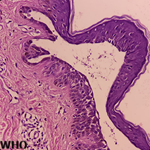
Pemphigus vulgaris is a chronic autoimmune blistering disorder characterised by intraepidermal bullae due to acantholysis caused by autoantibodies against desmogleins. A 35-year-old female presented with a 3-month history of painful oral ulcers followed by flaccid blisters predominantly over the abdominal region. The lesions initially appeared as fluid-filled vesicles over the abdomen, which ruptured easily to form painful erosions and crusted plaques. On examination, multiple irregular erosions and ruptured bullae were noted over the abdominal skin, with surrounding erythema. Nikolsky´s sign was positive. There was no history of drug intake or systemic illness. Routine investigations were unremarkable except for mild anaemia. Tzanck smear showed acantholytic cells, supporting the diagnosis. A clinical diagnosis of pemphigus vulgaris with predominant abdominal involvement and oral mucosal lesions was made. The patient was advised of an ayurvedic management for 2 weeks. Daily therapeutic purgation (nitya virechana) was employed as a principal shodhana modality to eliminate metabolic bio humour (vitiated pitta) and blood tissue (rakta) herbal digestive and mild laxative powder (triphala churna) 5 g at bedtime with lukewarm water for 21 days. Additionally, herbo-mineral anti-inflammatory tablets (kaishore guggulu) 500 mg, 2 tablets twice daily after food; blood-purifying herbal decoction (mahamanjishthadi kwatha) 40 ml twice daily before food; and purified sulfur-based rejuvenative formulation (gandhak rasayana) 250 mg twice daily after food for 2 weeks. External therapy included wound-healing medicated oil (jatyadi taila) applied locally twice daily and cleansing with antimicrobial herbal decoction (neem-triphala decoction) once daily. The treatment led to a significant reduction in new blister formation within 2 weeks, progressive healing of erosions and near-complete re-epithelialization by 4 weeks, indicating effective disease control and tissue regeneration.
Figure 1: a rare image of pemphigus vulgaris over the abdominal region
Search
This article authors
On Pubmed
On Google Scholar
Citation [Download]
Navigate this article
Similar articles in
Key words
Tables and figures

Article metrics
Recently from the PAMJ



Authors´ services