
Papillary thyroid carcinoma with Hashimoto's thyroiditis: a clinical image
Shubham Kalode, Punam Sawarkar
Corresponding author: Punam Sawarkar, Department of Panchakarma, Mahatma Gandhi Ayurved College, Hospital and Research Centre, Datta Meghe Institute of Higher Education and Research, Salod (H), Wardha, Maharashtra, India 
Received: 31 Jan 2026 - Accepted: 07 Feb 2026 - Published: 24 Mar 2026
Domain: Laboratory medicine,Endoscopic surgery,Otolaryngology (ENT)
Keywords: Papillary thyroid carcinoma, Hashimoto's thyroiditis, clinical image
Funding: This work received no specific grant from any funding agency in the public, commercial, or non-profit sectors.
©Shubham Kalode et al. Pan African Medical Journal (ISSN: 1937-8688). This is an Open Access article distributed under the terms of the Creative Commons Attribution International 4.0 License (https://creativecommons.org/licenses/by/4.0/), which permits unrestricted use, distribution, and reproduction in any medium, provided the original work is properly cited.
Cite this article: Shubham Kalode et al. Papillary thyroid carcinoma with Hashimoto's thyroiditis: a clinical image. Pan African Medical Journal. 2026;53:139. [doi: 10.11604/pamj.2026.53.139.51381]
Available online at: https://www.panafrican-med-journal.com//content/article/53/139/full
Images in clinical medicine 

Papillary thyroid carcinoma with Hashimoto's thyroiditis: a clinical image
Papillary thyroid carcinoma with Hashimoto´s thyroiditis: a clinical image
 Shubham Kalode1, Punam Sawarkar1,&
&Corresponding author

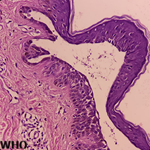
Papillary thyroid carcinoma is the most common malignant tumor of the thyroid gland and is frequently associated with chronic lymphocytic (Hashimoto´s) thyroiditis. A 45-year-old female presented with a gradually progressive anterior neck swelling of six months´ duration. There was no associated pain, dysphagia, dyspnea, or change in voice. Clinical examination revealed a firm, non-tender thyroid nodule without palpable cervical lymphadenopathy. Ultrasonography of the neck revealed a hypoechoic thyroid lesion with irregular margins. Fine needle aspiration cytology was suggestive of malignancy. Thyroidectomy was performed. Gross examination showed a firm gray-white, ill-defined lesion within the thyroid parenchyma. Histopathological examination demonstrated papillary architecture with fibrovascular cores lined by tumor cells exhibiting nuclear clearing, overlapping, nuclear grooves, and occasional intranuclear cytoplasmic inclusions. The surrounding thyroid tissue showed dense lymphoplasmacytic infiltration with formation of lymphoid follicles, consistent with Hashimoto´s thyroiditis. The patient underwent complete surgical excision of the tumor. The postoperative course was uneventful, and the patient was advised to undergo regular follow-up for further oncological management.
Figure 1: A) clinical photograph showing anterior neck swelling due to thyroid enlargement; B) gross thyroidectomy specimen showing an ill-defined firm nodular lesion (L- left lobe of thyroid, R- right lobe of thyroid); C) cut surface of thyroid gland revealing loss of normal architecture with firm infiltrative lesion; D) photomicrograph (H&E, low power) showing papillary structures with fibrovascular cores and surrounding dense lymphoid infiltration consistent with Hashimoto's thyroiditis
Search
This article authors
On Pubmed
On Google Scholar
Citation [Download]
Navigate this article
Similar articles in
Key words

Article metrics
Recently from the PAMJ






Authors´ services
