A case of perianal condylomata acuminata in a pregnant woman
Qi He, Jianping Zhou
Corresponding author: Jianping Zhou, First People's Hospital of Linping District, Hangzhou, China 
Received: 23 Nov 2025 - Accepted: 06 Dec 2025 - Published: 17 Dec 2025
Domain: Dermatology
Keywords: Pregnant women, condylomata acuminata, cryotherapy
Funding: This work received no specific grant from any funding agency in the public, commercial, or non-profit sectors.
©Qi He et al. Pan African Medical Journal (ISSN: 1937-8688). This is an Open Access article distributed under the terms of the Creative Commons Attribution International 4.0 License (https://creativecommons.org/licenses/by/4.0/), which permits unrestricted use, distribution, and reproduction in any medium, provided the original work is properly cited.
Cite this article: Qi He et al. A case of perianal condylomata acuminata in a pregnant woman. Pan African Medical Journal. 2025;52:164. [doi: 10.11604/pamj.2025.52.164.50331]
Available online at: https://www.panafrican-med-journal.com//content/article/52/164/full
Images in clinical medicine 

A case of perianal condylomata acuminata in a pregnant woman
A case of perianal condylomata acuminata in a pregnant woman
Qi He1, Jianping Zhou1,&
&Corresponding author

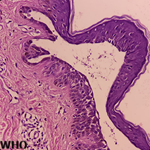
We report a case of perianal condylomata acuminata in a pregnant woman. The patient is a 28-year-old female. During a prenatal checkup in the third trimester of pregnancy, a large cauliflower structure was found around the anus. She then visited the dermatology department of our hospital. The patient's syphilis testing and HIV testing were both negative. Samples collected from genital lesions were positive for HPV types 6 and 11. Biopsy pathology suggests condylomata acuminata. Based on these examinations, we ultimately diagnosed it as perianal condylomata acuminata. We provided the patient with a cryotherapy treatment. Two weeks later, when the patient returned for a follow-up visit, it was observed that the perianal warts had increased in size compared to before. The patient refused to continue cryotherapy. The patient delivered a baby by cesarean section at 37 weeks without any complications. After delivery, our department provided three sessions of laser combined with photodynamic therapy, followed by regular follow-ups, and no recurrence was observed. We followed up on the newborn delivered by the patient before the age of one and found no warts.
Figure 1: A) a large cauliflower structure around the anus; B) perianal skin after treatment
Search
This article authors
On Pubmed
On Google Scholar
Citation [Download]
Navigate this article
Similar articles in
Key words
Tables and figures

Article metrics
Recently from the PAMJ



Authors´ services