
Cartilaginous conundrums: an integrated approach to synovial chondromatosis diagnosis
Suhit Naseri, Kishor Hiwale
Corresponding author: Suhit Naseri, Department of Pathology, Jawaharlal Nehru Medical College, Sawangi, India 
Received: 19 Mar 2024 - Accepted: 07 Sep 2025 - Published: 26 Nov 2025
Domain: Oncology,Orthopedic surgery,Surgical oncology
Keywords: Cartilage diseases, integrated approach, diagnostic imaging
Funding: This work received no specific grant from any funding agency in the public, commercial, or non-profit sectors.
©Suhit Naseri et al. Pan African Medical Journal (ISSN: 1937-8688). This is an Open Access article distributed under the terms of the Creative Commons Attribution International 4.0 License (https://creativecommons.org/licenses/by/4.0/), which permits unrestricted use, distribution, and reproduction in any medium, provided the original work is properly cited.
Cite this article: Suhit Naseri et al. Cartilaginous conundrums: an integrated approach to synovial chondromatosis diagnosis. Pan African Medical Journal. 2025;52:128. [doi: 10.11604/pamj.2025.52.128.43324]
Available online at: https://www.panafrican-med-journal.com//content/article/52/128/full
Images in clinical medicine 

Cartilaginous conundrums: an integrated approach to synovial chondromatosis diagnosis
Cartilaginous conundrums: an integrated approach to synovial chondromatosis diagnosis
 Suhit Naseri1,&, Kishor Hiwale1
&Corresponding author

Synovial chondromatosis is a rare benign disorder characterized by the development of numerous cartilaginous nodules within the synovial membrane of joints, primarily affecting the knee. The typical onset is in the 30s-50s, with an incidence rate of 1 in 100,000 and a male-to-female ratio of 1.8:1. We report a case of a 24-year-old male patient who presented with progressively worsening right knee pain, swelling, and limited range of motion persisting for over a month. There was no history of trauma or previous joint disorders. The skin on the surface of the mass was free from redness, swelling and ulceration, and no venous bulging. Initial radiographic imaging of the knee showed multiple intra-articular calcified bodies, suggestive of synovial chondromatosis. Magnetic resonance imaging (MRI) further characterized the extent of synovial involvement and the presence of loose bodies within the joint space. Synovial fluid analysis was unremarkable, ruling out infection or inflammatory arthritis. Arthroscopic removal of the swelling revealed synovial hypertrophy and multiple cartilaginous nodules ranging in size from a few millimeters to several centimeters. The nodules were firm and lobulated, with a smooth and glistening surface. Histopathological examination confirmed the diagnosis of synovial chondromatosis, demonstrating clusters of mature hyaline cartilage with focal areas of calcification. Synovial chondromatosis is a rare but important differential diagnosis in patients presenting with joint pain and swelling, particularly in the absence of trauma or inflammatory conditions. Early recognition, accurate diagnosis, and appropriate management, including surgical intervention when indicated, lead to favorable outcomes and improved quality of life for affected individuals.
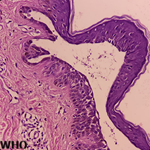
Figure 1: A) X-ray of right knee (lateral view) depicting multiple condromatosis; B) axial magnetic resonance imaging sections showing multiple loose bodies around the knee; C) gross image of the lesion showing surgically excised multiple synovial chondromatosis lesions; D) microscopy of the lesion showing multiple hyaline cartilage nodules
Search
This article authors
On Pubmed
On Google Scholar
Citation [Download]
Navigate this article
Similar articles in
Key words

Article metrics
Recently from the PAMJ






Authors´ services
