Giant palpebral hidrocystoma
Youssef Zemmez, Naoufal Hjira
Corresponding author: Youssef Zemmez, Department of Dermatology-Venereology, Mohammed V Military Training Hospital, Rabat, Morocco 
Received: 24 Oct 2025 - Accepted: 01 Nov 2025 - Published: 17 Nov 2025
Domain: Dermatology
Keywords: Hidrocystoma, giant, surgery
Funding: This work received no specific grant from any funding agency in the public, commercial, or non-profit sectors.
©Youssef Zemmez et al. Pan African Medical Journal (ISSN: 1937-8688). This is an Open Access article distributed under the terms of the Creative Commons Attribution International 4.0 License (https://creativecommons.org/licenses/by/4.0/), which permits unrestricted use, distribution, and reproduction in any medium, provided the original work is properly cited.
Cite this article: Youssef Zemmez et al. Giant palpebral hidrocystoma. Pan African Medical Journal. 2025;52:115. [doi: 10.11604/pamj.2025.52.115.49927]
Available online at: https://www.panafrican-med-journal.com//content/article/52/115/full
Images in clinical medicine 

Giant palpebral hidrocystoma
Giant palpebral hidrocystoma
Youssef Zemmez1,&, Naoufal Hjira1
&Corresponding author

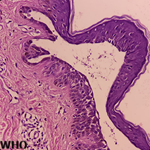
Hidrocystoma belongs to benign tumors of sweat glands. It varies in size from a few millimeters to 1,5 cm in rare cases. We report an atypical case of giant hidrocystoma of the eyelid. This is a 52-year-old female patient with no particular medical history who presented at a dermatology clinic with skin lesions on both eyelids that had been developing for twenty years. Dermatological examination revealed multiple budding tumor lesions that were soft and painless on palpation, brownish-yellow in color, affecting the upper left and right eyelids as well as the inner canthi on both sides. The patient was referred to plastic surgery for an excisional biopsy, and histology confirmed the diagnosis of multiple hydrocystomas. Palpebral hidrocystomas are benign tumors also known as cystic apocrine adenoma, cyst of sweat gland, apocrine retention cyst or cyst of Moll. They originate from eccrine or apocrine sweat glands and often occur on the face and the eyelids. Other atypical locations such as the chest, the shoulders and the foreskin have been reported. Hidrocystoma is a small translucent, shiny cyst. It appears as single or multiple cystic lesions.
Figure 1: A) right eyelid hidrocystoma; B) left eyelid hidrocystoma
Search
This article authors
On Pubmed
On Google Scholar
Citation [Download]
Navigate this article
Similar articles in
Key words
Tables and figures

Article metrics
PlumX Metrics
Giant palpebral hidrocystomaRecently from the PAMJ






Authors´ services