
eISSN: 1937-8688

Beaver in the liver

Mohamad Syafeeq Faeez Md Noh, Siti Jusna @ Siti Sharifah Muhammad

PAMJ. 2017; 27:138. Published 23 Jun 2017 | DOI: 10.11604/pamj.2017.27.138.12227
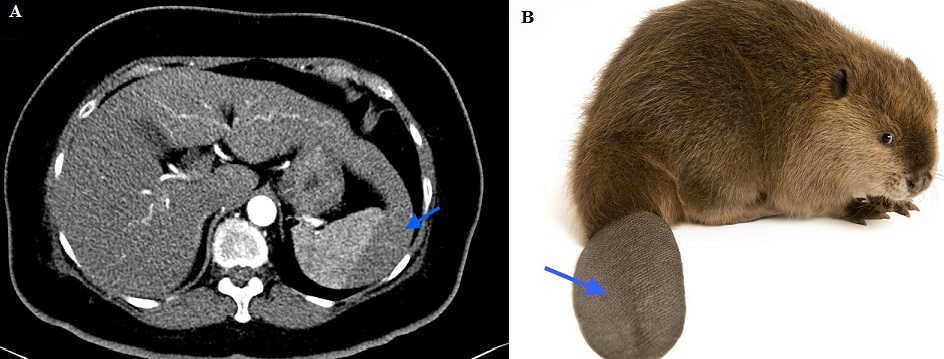
Beaver in the liver
A 60-year-old woman with a congenital solitary right kidney presented with 1 month history of right flank pain associated with hematuria and urinary tract infection (UTI) symptoms. A Computed tomography (CT) was done in view of the precious kidney, and revealed features suggestive of right obstructive uropathy with pyelonephritis; for which appropriate treatment was subsequently instituted. Incidentally, an elongated left liver lobe was discovered. This anatomical variant, also known as 'Beaver tail liver' is seen to be extending beyond the spleen, almost encasing it entirely (A). The term was coined due to its resemblance to the tail of a beaver (B). Although not widely reported in the medical literature, the presence of this variant has a few clinical implications. When present, lesions occurring in the elongated left lobe may be missed on ultrasonography (USG). In cases of trauma, injury to the left side of the abdomen which classically affects the spleen, may affect the elongated left liver lobe. It may also be mistaken for a splenic hematoma. Operative intervention, when pursued without prior knowledge of its presence, may result in unwanted complications. In essence, clinicians should be aware of its occurrence and clinical significance; as this may influence patient management and treatment outcome.

Corresponding Author

Mohamad Syafeeq Faeez Md Noh, Department of Imaging, Faculty of Medicine and Health Sciences, Universiti Putra, Malaysia (msf.mdnoh@gmail.com)

Article Formats

Articles published in Pan African Medical Journal are Open Access and distributed under the terms of the Creative Commons Attribution 4.0 International (CC BY 4.0).

Open Access Logo

The Pan African Medical Journal (ISSN: 1937-8688) is a product of the PAMJ. The contents of this journal is intended exclusively for professionals in the medical, paramedical and public health and other health sectors.