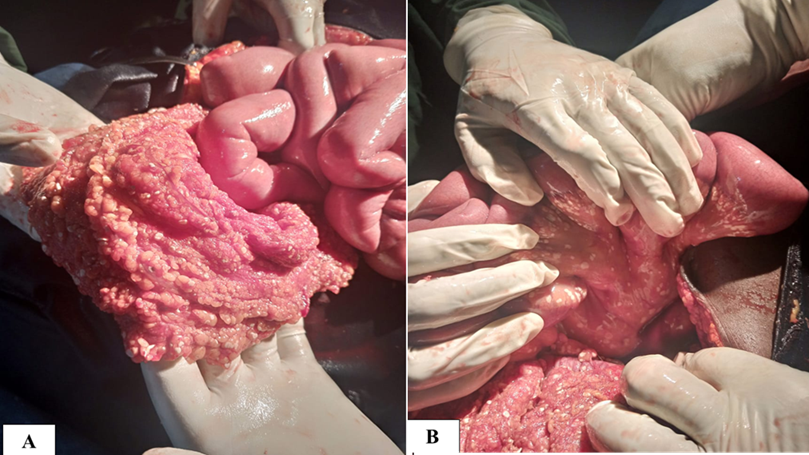
Acute hemorrhagic pancreatitis may be accompanied by extensive enzymatic fat necrosis. We report a characteristic intraoperative finding of “candle-wax” lesions, corresponding to waxy deposits of saponified fat on the omentum and mesentery. A 31-year-old man with a history of alcohol consumption and a body mass index of 28 kg/m<sup>2</sup> was admitted with a 48-hour history of acute abdominal pain. On presentation, he exhibited hemodynamic shock, marked cutaneomucosal pallor, and abdominal guarding. Initial laboratory tests showed anemia (hemoglobin 8 g/dL), normal blood glucose, elevated urea and creatinine, and markedly increased serum lipase. Abdominal ultrasonography revealed intraperitoneal fluid without evidence of biliary lithiasis. In this context, a diagnosis of alcohol-induced acute pancreatitis was established, with a perforated gastric ulcer as the main differential diagnosis. Initial management included hemodynamic stabilization and antacid therapy, followed by an emergency exploratory laparotomy. Intraoperatively, a large hematic effusion was evacuated, and the pancreas appeared markedly edematous and hemorrhagic. Multiple whitish plaques were observed on the omentum and mesentery, displaying the classic “candle-wax” appearance consistent with enzymatic fat necrosis. The procedure was completed with thorough peritoneal lavage and placement of lamellar drains. The early postoperative course was marked by severe oligo-anuric renal failure. This distinctive pattern represents a rare but highly informative manifestation of fat necrosis in severe acute pancreatitis. Its intraoperative identification carries important diagnostic and educational value.
Corresponding Author
Trésor Kabuya Kabamba, Department of Surgery, Université Officielle de Mbujimayi, Mbujimayi, Democratic Republic of the Congo (tresor.kabuya@uom.cd)