Prospective study of the relevance of the colonoscopy indication according to the criteria of the European Panel on the appropriateness of gastrointestinal endoscopy in two digestive endoscopy centers in Cotonou, Republic of Benin, in 2024
Aboudou Raïmi Kpossou, Comlan Martin Sokpon, Gilles Fréjus Gbaguidi, Fadel Sourokou, Rodolph Vignon, Jean Sehonou
Corresponding author: Aboudou Raïmi Kpossou, University Clinic of Hepato-Gastroenterology, National University Hospital Center - Hubert Koutoukou Maga (CNHU-HKM), Cotonou, Benin 
Received: 21 Feb 2026 - Accepted: 01 Jun 2026 - Published: 01 Oct 2026
Domain: Gastroenterology
Keywords: Endoscopy, colonoscopy, relevance, indication, colorectal polyps, colorectal tumor, EPAGE, Benin
Funding: This work received no specific grant from any funding agency in the public, commercial, or non-profit sectors.
This article is published as part of the supplement Hepatogastroenterology and Digestive Oncology, commissioned by African Journal of Hepatogastroenterology and Digestive Oncology (RAHGOD) and the African Society of Hepatogastroenterology Digestive Endoscopy (SAHGE).
©Aboudou Raïmi Kpossou et al. Pan African Medical Journal (ISSN: 1937-8688). This is an Open Access article distributed under the terms of the Creative Commons Attribution International 4.0 License (https://creativecommons.org/licenses/by/4.0/), which permits unrestricted use, distribution, and reproduction in any medium, provided the original work is properly cited.
Cite this article: Aboudou Raïmi Kpossou et al. Prospective study of the relevance of the colonoscopy indication according to the criteria of the European Panel on the appropriateness of gastrointestinal endoscopy in two digestive endoscopy centers in Cotonou, Republic of Benin, in 2024. Pan African Medical Journal. 2026;55(1):4. [doi: 10.11604/pamj.supp.2026.55.1.51748]
Available online at: https://www.panafrican-med-journal.com//content/series/55/1/4/full
 PDF in process
Research 
Prospective study of the relevance of the colonoscopy indication according to the criteria of the European Panel on the appropriateness of gastrointestinal endoscopy in two digestive endoscopy centers in Cotonou, Republic of Benin, in 2024
Prospective study of the relevance of the colonoscopy indication according to the criteria of the European Panel on the appropriateness of gastrointestinal endoscopy in two digestive endoscopy centers in Cotonou, Republic of Benin, in 2024
 Aboudou Raïmi Kpossou1,2,3,&, Comlan Martin Sokpon1, Gilles Fréjus Gbaguidi², Fadel Sourokou4, Rodolph Vignon1,2, Jean Sehonou1,2
&Corresponding author
Introduction: the European Panel on the Appropriateness of Gastrointestinal Endoscopy (EPAGE) has established criteria to assess the appropriateness of a colonoscopy indication. This work aimed to assess the applicability of these criteria in health facilities in Benin in 2024.
Methods: this was a descriptive and analytical cross-sectional study with prospective data collection. It was carried out for three months at Mènontin Hospital and International Clinic of Cotonou-Aupiais. The suitability of colonoscopy was assessed based on the EPAGE II criteria at the www.epage.ch site.
Results: a total of 122 people, including 69 men (56.6%). The mean age was 53.9 ± 2.5 years. The EPAGE II criteria were applicable in 93.4% of cases. Colonoscopy indications were relevant in 58.9% of cases, of which 33.6% were appropriate indications, and 26.2% were necessary indications; 18% were uncertain indications, and 15.6% were inappropriate indications. Colorectal abnormalities were observed in 86.9% of patients, dominated by internal hemorrhoidal disease (38.5%). Significant colorectal lesions (colorectal polyp, malignant-looking colorectal tumor, colonic diverticulosis, inflammatory colitis) were detected in 35.3% of clinically relevant situations, in 7.4% of inappropriate situations and in 0.8% of inapplicable situations, where it was a case of malignant-looking colorectal tumor.
Conclusion: in this study, the indications were relevant in more than half of the cases and significant colorectal lesions were detected in more than one-third of the cases, including in some non-relevant indications according to EPAGE II. It is therefore necessary to establish criteria regulating the performance of a colonoscopy in our socio-economic context while being very objective.

Colonoscopy is a fundamental tool in the field of gastroenterology, allowing the diagnosis and screening of various colorectal pathologies. This is a medical examination that requires the use of a flexible tube. However, as it is invasive, the use of lower gastrointestinal endoscopy must be judicious and based on precise clinical criteria to reduce, among other things, possible complications, the main ones being perforation and haemorrhage [1].
European Panel on the Appropriateness of Gastrointestinal Endoscopy (EPAGE) is an organisation composed of renowned European specialists in the field of gastroenterology and endoscopy. EPAGE provides detailed guidelines [2] to solve the problem of increasing colonoscopy demands and improve its rational use [3]. Its main objective is to evaluate the relevance of gastrointestinal endoscopies, defining appropriate criteria for their use. As resources are limited in some regions, meeting these criteria can be beneficial [4]. It is with this in mind that the criteria initially proposed in 1998 [5] EPAGE I were updated in 2008 to EPAGE II. They have been developed on the basis of the best available scientific evidence [2]. Thus, colonoscopy in European countries is intended for patients with precise indications and clinical data.
Very few African studies have been carried out to assess the validity of these European criteria in medical practice, taking into account our socio-economic and technical realities. As such research has not been done to our knowledge in Benin, we proposed to carry out the present work following the example of the study carried out in 2023 on the relevance of upper digestive endoscopy in Cotonou according to these same European criteria [6]. To reduce the requests for colonoscopies by Beninese practitioners to the relevant indications, we have proposed to carry out the present study. This study aimed to evaluate the relevance of the indication for colonoscopy in hospitals in Cotonou according to the criteria of EPAGE II.

Study design and setting: this was a prospective validation study. It was conducted from September 30, 2024, to December 31, 2024 (three months) in the digestive endoscopy departments of Mènontin Hospital and International Clinic of Cotonou Aupiais (CICA). Through this study, we set ourselves the objectives of establishing the level of compliance of the colonoscopy indications prescribed in Cotonou with the EPAGE II criteria and to highlight the impact of compliance with these criteria on the detection of significant colorectal lesions.
Study population: the study population consisted of all patients referred for lower gastrointestinal endoscopy in these two centers during the study period. Any patient aged 18 years or older who had been referred for colonoscopy and who had given free and informed verbal consent was included. An exhaustive census was carried out of all patients meeting the criteria described above. All patients who had already been initially included for a diagnostic or screening colonoscopy and who had been rescheduled for interventional colonoscopy were excluded. Patients who did not give consent were also not included. We conducted a non-probability convenience sampling with an exhaustive census of patients meeting the inclusion criteria.
Data collection: verbal consent was obtained from the patient himself. The data collection was initially done through an interrogation of the patient based on the questions on the pre-established survey form. The investigation form was then completed with the final result of the colonoscopy and the collection of the patient's impressions of the examination. The data collection tools were a questionnaire that had been used as a survey sheet; the EPAGE software available on www.epage.ch; and the report of the colonoscopy performed.
Definitions: the relevance of the indications for the colonoscopy performed had been evaluated according to the criteria of EPAGE II. These indications are presented in the form of a rating matrix and simplified via the EPAGE software available on www.epage.ch [2]. i) colonoscopy is appropriate if median score ≥ 7; ii) colonoscopy is required if appropriate and median need ≥ 7; iii) colonoscopy is inappropriate if median score ≤ 3; iv) colonoscopy is uncertain if median score > 3 and < 7.
According to the EPAGE II criteria, indications are considered relevant when appropriate or necessary and are irrelevant when they are uncertain, inappropriate or inapplicable. An indication is inapplicable when it is not included in the list of identified reasons for colonoscopy. At colonoscopy, the following lesions were considered significant colorectal lesions: colonic or rectal polyp, malignant-looking colorectal tumor, diverticulosis of the colon, inflammatory colitis.
Statistical analysis: the data collected had been computerised and processed with Epi Info version 7.2.1.0 and SPSS (Statistical Package for Social Sciences) version 25 software. Microsoft Word 2019 was used to enter the thesis, and Excel 2019 to organise the data in the form of tables and graphs. Once the collected data were entered into the software, we checked for any input errors and assessed the consistency of the information before coding it. During the analysis, some quantitative parameters were categorised. To compare the qualitative variables, the Pearson Chi-square test was used. P values below 5% were considered statistically significant.
Ethical considerations: a favourable agreement from the Ethics Committee for Research in Health Sciences (CER-SS) before the start of the investigation (Decision No. 008-2024/CER-SS). We obtained written consent from patients after explaining the purpose of the study. The information obtained from each patient was completely confidential and could not be disclosed.
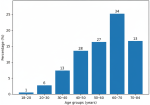
Characteristics of the study population: a total of 122 patients were enrolled in the study, of which 86 (70.5%) were at Mènontin hospital and 36 at CICA. The majority of patients came from the Hubert Koutoukou Maga National University Hospital Center (CNHU-HKM) and private clinics, respectively (n=53; 43.4%) and (n=43; 35.2%). The male sex was more represented (56.6%; n=69) with a sex ratio of 1.3. The average age was 53.9 ± 2.5 years, with extremes of 18 and 84 years. The modal age group was 60 to 69 years (27.9%; n=34) (Figure 1). The study population was mainly made up of people working in the private sector (30.3%; n=37), followed by retirees (22.1%; n=27). The majority of the population studied had a monthly income of between 70.98 USD and 177.46 USD (n=45; 36.9%), and 18 patients (14.8%) had an income of less than 70.98 USD (Table 1).
Data related to the colonoscopy performed: colonoscopy was prescribed for diagnostic purposes in 120 patients (98.4%) and for screening purposes in 2 patients (1.6%). Biopsies for histopathological examination were performed in 42 patients (35.9%). The clinical situations of EPAGE II were relevant in 73 patients, i.e. 59.8% of cases, of which 33.6% were appropriate, and 26.2% were necessary; and not relevant in 49 patients, of which 18% (n=22) were uncertain, 15.6% (n=19) were inappropriate, and 6.6% (n=8) were inapplicable. The inapplicable indications were dominated by haemorrhoidal disease (Table 2). Constipation was the most frequent clinical endpoint for EPAGE II (n=46; 40.3%) found in our series, followed by hematochezia (n=31; 25.4%) and abdominal pain (n=22; 18%). As for endoscopic findings, colonoscopy was normal in 13.1% (n=16) of patients and revealed a colorectal abnormality in 86.2% (n=106). The most common anomaly found was proctological. It was IHDs in 38.5% (n=47) of patients. The most objectified colonic anomaly was colorectal polyp in 29 patients (23.8%) (Table 3). In this study, significant colorectal lesions were detected in 55 patients (45.1%). Colonic polyp was also the most common significant colorectal lesion in patients (n=29; 23.8%). In the situations considered relevant, colonic polyp was the most common significant colorectal lesion (18%). Malignant-looking colorectal tumor and diverticulosis were in equal proportion, with 8.2% each. In situations considered uncertain, the most common significant colorectal lesion was colonic polyp (n=6; 4.9%). In situations deemed inappropriate, colonic polyp and diverticulosis were also in equal proportion (n=1; 0.8%). In situations considered inappropriate, malignant-looking colorectal tumor was noted in a patient in this clinical status group (Table 4).
Factors associated with the appropriateness of the colonoscopy indication in the clinical situations of EPAGE II (Table 5): in the clinical situations of EPAGE II deemed relevant (appropriate and necessary), men were more represented (n=42; 34.4%) versus (n=31; 25.6%) for women. However, there is no significant association between sex and the relevance of the indication for their colonoscopy in our study (P=.4; X² = 0.006; df = 1). Patients aged 55 years or older were the most represented in the relevant situations of EPAGE II (n=52; 42.6%) compared to (n=70; 57.4%) for those under 55 years of age. Patients aged 55 years or older had indications significantly associated with the appropriateness of colonoscopy (P<.001; X² = 11,36; df = 1). They were about 10 times more likely to be ranked relevant. Therefore, the older the subjects, the more relevant colonoscopy was. In our series, hematochezia and abdominal pain were the indications significantly associated with the relevance of the examination (P<.001, respectively; X² = 19.62; df = 2). Patients referred for hematochezia were 7 times more likely to be classified as relevant. On the other hand, those referred for abdominal pain had an 80% reduced probability of being considered relevant cases. The association between the presence of a colorectal polyp and the appropriateness of the colonoscopy indication was also statistically significant (P=.04; X² = 0.13; df = 2). The detection of a colorectal polyp was 3 times more likely to be associated with a clinically relevant situation according to EPAGE II (Table 5).
This study aimed to evaluate the relevance of the indication for colonoscopy in hospitals in Cotonou according to the criteria of EPAGE II. We included in our study a total of 122 patients, 70.5% of whom had been recruited at Menontin Hospital. This can be explained by the fact that it was the only hospital in the public sector that had an operational lower digestive endoscopy service; the colonoscope of Hubert Koutoukou Maga National University Hospital Center (CNHU-HKM) was not operational during our study period. As for the medical structure of origin of the patients, the majority came from CNHU-HKM. This could be due to the status of this center as a reference hospital in the national health pyramid and the fact that this hospital has a significant human resource with four gastroenterologist practitioners.
The median age of patients in our study was 53.9 years, with extremes of 18 years and 84 years. In our series, an age of 55 years or older was statistically associated with an indication deemed relevant according to the EPAGE II criteria. The approximate financial cost of performing the colonoscopy, including the costs of general anaesthesia products and procedures, the colonoscopy itself and others, exceeds an amount of 177,62 USD at Menontin Hospital. However, 36.9% of the patients in our study had a monthly income of between 70.98 USD and 177.46 USD; and 14.8% of patients had an income of less than 70.98 USD, therefore below the guaranteed minimum interprofessional wage in Benin, which is 92,36 USD [7]. This testifies to the low economic level of the Beninese population, with the corollary of difficulty in accessing health care.
The majority of colonoscopies performed were prescribed by medical specialists: 69.7% by gastroenterologists and 27% by surgeons. In medical practice, patients are usually, as far as possible, referred to a specialist doctor for better management, which could explain this result. There was also no statistically significant association between prescriber qualification and the appropriateness of the colonoscopy indication. We hold that it was therefore not necessary to limit the prescription of this examination to a category of doctors to have relevant indications.
In the group of 122 patients included, our study found 59.8% of relevant indications according to the criteria of EPAGE II. Constipation, hematochezia and abdominal pain were the most represented indications in our study, and constipation motivated the prescription of a colonoscopy in 37.7% of cases. Only hematochezia and abdominal pain were the indications statistically associated with relevance according to EPAGE II. Indeed, patients referred for hematochezia were about 7 times more likely to be classified as relevant cases. On the other hand, those referred for abdominal pain had an 80% reduced probability of being considered relevant cases.
This could be explained by the fact that hematochezia, like any digestive haemorrhage, was a medical emergency. We could also remember that abdominal pain should not immediately lead to a colonoscopy. In this study, the most detected significant colorectal lesions were colorectal polyps, diverticulosis and malignant-looking colorectal tumors. These lesions were mostly found in the relevant colonoscopy indications. But 12 cases were detected in the irrelevant cases. It could be concluded that the EPAGE II criteria would need to be updated, as significant colorectal lesion detection was observed among the irrelevant indications. This study was, to our knowledge, the first carried out in Benin on the relevance of the indication for colonoscopy according to the criteria of EPAGE II. It follows a similar research work on upper digestive endoscopy carried out in Benin in 2023, from which we were somewhat inspired [6]. These results would make it possible to refine the criteria for prescribing colonoscopy in our country, whose medico-technical resources are limited. The main inadequacy of this scientific work is the fact that the histological results of biopsy specimens are not taken into account for various reasons.
This median age was similar to that reported by Gimeno Garcia et al. [4] in Spain in 2009. This conclusion could be explained by the existence of systematic screening for colorectal lesions introduced in some European countries from a given age group, as is the case in France with the haute autorité de santé in patients aged 50 to 74 who are asymptomatic [8]. Hammami et al. [9] obtained similar results in Tunisia about the male sex represented. Gender inequality, poverty and the low economic empowerment of women in developing countries are obstacles to access to health care by women, especially in the African region, as demonstrated by a study by Integrated African Health Observatory in 2023 [10].
Regarding relevant indications, our result was lower than that of Gimeno García et al. [4], who had found 77.5% of relevant indications in Spain in 2009. As a result, the indications for colonoscopy were not always relevant, and the prevalence of relevant cases was high in Europe. Marzo-Castillejo et al. [11] and Samarakoon et al. [12] had found that it was hematochezia that dominated the reasons for a colonoscopy. Hammami et al. [9] and Marzo-Castillejo et al. [11] found similar results in detecting significant colorectal lesions also among the indications deemed irrelevant. From this comparison, it could be concluded that the relevant situations of EPAGE II would only increase the chance of detection of significant colorectal lesions.
This study has made it possible to evaluate the relevance of the reasons for colonoscopy in Benin according to the criteria of EPAGE II. This work can therefore make it possible to adapt the EPAGE II criteria to local realities. Taking into account the shortcomings of the present study, it would be essential to carry out this scientific work on a large scale in order to have a significant sample size. It would also be interesting to include the results of lesions biopsied during colonoscopy. This would make it possible to establish a correlation between the relevance of the colonoscopy and the nature of the lesions found. The results of this study may not be related to those of the general population in Benin, mainly because of the relatively small sample size. This could be explained by the technical problems during the entire study period with the colonoscopy machines of the digestive endoscopy department of CNHU-HKM, which was one of the settings initially selected for the present study.
The study found that the indications were relevant in nearly 6 out of 10 cases. The results obtained shed light on the relevance of European recommendations in our local context and underline the importance of adapting international guidelines to the specificities of the national health system. In this perspective, additional studies would be necessary to refine these criteria taking into account local constraints and to promote a better awareness among practitioners regarding the application of the recommendations of EPAGE II.
What is known about this topic
- Colonoscopy is a crucial examination in gastroenterology for the detection and diagnosis of colorectal lesions;
- Colonoscopy should not be an unregulated examination to limit the complications of such an act;
- EPAGE II provides criteria for performing colonoscopy in Europe.
What this study adds
- This study shows the limits in the local context of the application of these European criteria;
- This study demonstrates the usefulness of establishing criteria for performing colonoscopy adapted to local socio-economic situations.
The authors declare no competing interests.
Conception and study design: Aboudou Raïmi Kpossou, Comlan Martin Sokpon, Rodolph Vignon. Data collection: Gilles Fréjus Gbaguidi. Data analysis and interpretation: Aboudou Raïmi Kpossou, Comlan Martin Sokpon, Gilles Fréjus Gbaguidi, Rodolph Vignon and Jean Sehonou. Manuscript drafting: Aboudou Raïmi Kpossou and Gilles Fréjus Gbaguidi. Manuscript revision: Aboudou Raïmi Kpossou and Jean Sehonou. Guarantor of the study Aboudou Raïmi Kpossou. All the authors have read and approved the final version of this manuscript.
We would also like to thank all the patients who have given their consent to the collection of the various information concerning them.
Table 1: distribution by monthly income of patients who underwent colonoscopy, Cotonou 2024
Table 2: distribution of patients who have undergone colonoscopy according to the EPAGE II situations, Cotonou 2024
Table 3: distribution according to the endoscopic results of the examination of patients who performed colonoscopy, Cotonou 2024
Table 4: distribution of significant colorectal lesions according to the clinical situations of EPAGE II in patients who have undergone colonoscopy, Cotonou 2024
Table 5: factors associated with the relevance of colonoscopy according to EPAGE II criteria in patients who have undergone colonoscopy, Cotonou 2024 (N=122)
Figure 1: age distribution of patients who performed colonoscopy, Cotonou 2024
- Cesbron-Métivie E. Gestion des complications endoscopiques de la coloscopie. FMC-HGE. 2019. Accessed February 17, 2025. Google Scholar
- Juillerat P, Peytremann-Bridevaux I, Vader J, Arditi C, Schusselé Filliettaz S, Dubois R et al. Appropriateness of colonoscopy in Europe (EPAGE II). Presentation of methodology, general results, and analysis of complications. Endoscopy. 2009 Mar;41(3):240-6. PubMed | Google Scholar
- Hellara O, Debbabi A, Chaabene N, Mansour W, Loghmari H, Melki W et al. Appropiateness of colonoscopy in the university hospital center of monastir. Interest and applicability of criteria established by the European panel on the appropriateness of gastrointestinal endoscopy. Tunis Med. 2014 Feb;92(2):135-40. PubMed | Google Scholar
- Gimeno García A, González Y, Quintero E, Nicolás-Pérez D, Adrián Z, Romero R et al. Clinical validation of the European Panel on the Appropriateness of Gastrointestinal Endoscopy (EPAGE) II criteria in an open-access unit: a prospective study. Endoscopy. 2012 Jan;44(1):32-7. PubMed | Google Scholar
- De Bosset V, Gonvers JJ, Vader JP, Dubois RW, Burnand B, Froehlich F. 9. Appropriateness of colonoscopy: lower abdominal pain or constipation. Endoscopy. 1999 Oct;31(8):637-40. PubMed | Google Scholar
- HINVI S. Pertinence de l'indication de l'endoscopie digestive haute selon les critères de l'European Panel on the appropriateness of gastrointestinal endoscopy à l'hôpital de zone de Ménontin au Bénin en 2022 [thesis]. Cotonou: Faculté des Sciences de la Santé; 2022. 172 p.
- Wage Indicator Foundation. Minimum Wage - Bénin. WageIndicator. 2025. Accessed February 13, 2025.
- Haute Autorité de santé. Cancer colorectal: modalités de dépistage et de prévention chez les sujets à risque élevé et très élevé. HAS. Mai 2017. Accessed February 13, 2025.
- Hammami A, Hassine A, Sahli J, Ghali H, Ben Saad O, Elleuch N et al. Appropriateness of colonoscopies in a Tunisian endoscopy center: factors and EPAGE-I/II criteria comparison. BMC Gastroenterol. 2024 Aug 19;24(1):272. PubMed | Google Scholar
- iAHO, Integrated African Health Observatory. La santé de la femme dans la Région africaine. Mars 2003. Accessed February 13, 2025.
- Marzo-Castillejo M, Almeda J, Mascort J, Cunillera O, Saladich R, Nieto R et al. Appropriateness of colonoscopy requests according to EPAGE-II in the Spanish region of Catalonia. BMC Fam Pract. 2015 Oct 26;16:154. PubMed | Google Scholar
- Samarakoon Y, Gunawardena N, Pathirana A, Hewage S. "Appropriateness of colonoscopy according to EPAGE II in a low resource setting: a cross sectional study from Sri Lanka". BMC Gastroenterol. 2018 May 29;18(1):72. PubMed | Google Scholar
Search
This article authors
On Pubmed
On Google Scholar
Citation [Download]
Navigate this article
Similar articles in
Key words
Tables and figures

Article metrics
Map loading delayed...
Recently from the PAMJ




Authors´ services