Fifty years of immunisation in Africa: the evolution of vaccine supply chains
Chinwe Juliana Iwu-Jaja, Akhona Victress Mazingisa, Chidozie Declan Iwu, Charles Shey Wiysonge
Corresponding author: Chinwe Juliana Iwu-Jaja, World Health Organization Regional Office for Africa, Brazzaville, Congo 
Received: 30 Aug 2025 - Accepted: 05 Oct 2025 - Published: 10 Oct 2025
Domain: Vaccine cold chain,Vaccine logistic,Global health
Keywords: Vaccine supply chain, immunisation, Africa, cold chain, logistics, digital health systems, local manufacturing, health security
Funding: This work received no specific grant from any funding agency in the public, commercial, or non-profit sectors.
This article is published as part of the supplement Fifty years of the Expanded Programme on Immunisation in Africa, commissioned by Vaccine Preventable Disease (VPD) Programme, WHO Regional Office for Africa; UNICEF Eastern and Southern Africa Regional Office, UNICEF West and Central Africa Regional Office.
©Chinwe Juliana Iwu-Jaja et al. Pan African Medical Journal (ISSN: 1937-8688). This is an Open Access article distributed under the terms of the Creative Commons Attribution International 4.0 License (https://creativecommons.org/licenses/by/4.0/), which permits unrestricted use, distribution, and reproduction in any medium, provided the original work is properly cited.
Cite this article: Chinwe Juliana Iwu-Jaja et al. Fifty years of immunisation in Africa: the evolution of vaccine supply chains. Pan African Medical Journal. 2025;51(1):28. [doi: 10.11604/pamj.supp.2025.51.1.49186]
Available online at: https://www.panafrican-med-journal.com//content/series/51/1/28/full
 PDF in process
 Essay 
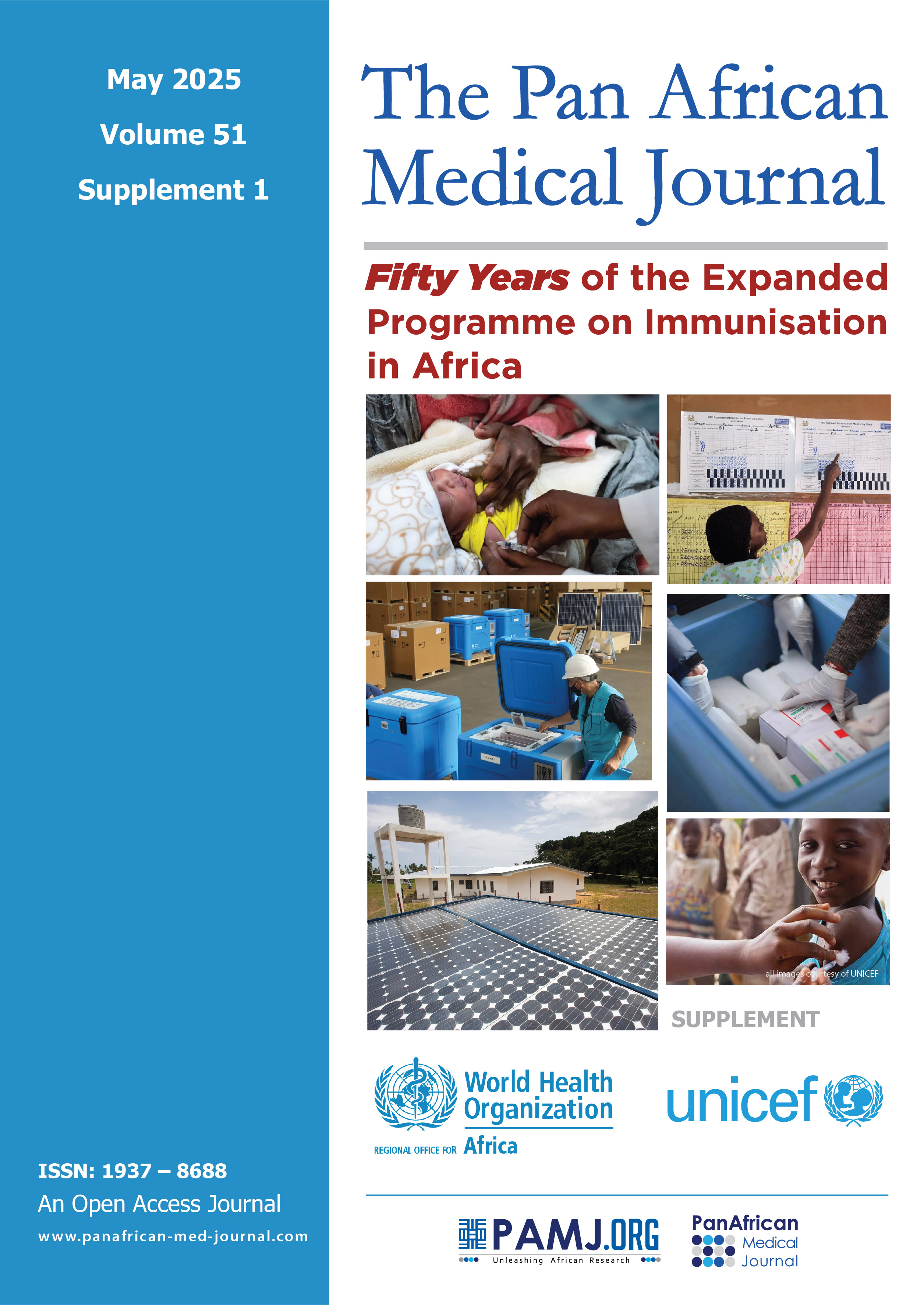
Fifty years of immunisation in Africa: the evolution of vaccine supply chains
Translating Africa's local vaccine ambition into measurable benchmarks: a Country Readiness Assessment Index (CRAI) to accelerate Africa's vaccine manufacturing
Uchenna Anderson Amaechi1,&, Justice Nonvignon2,3, Chukwudi Arnest Nnaji4,5, Kelechi Julian Uzor6,7, Ryuichi Komatsu8,9, Solomon Nwaka10,  Nicolas Ray1
&Corresponding author
Political leaders have pledged that 60% of Africa's routine vaccines will be produced on the continent by 2040, an ambitious target given that the continent currently produces less than 1% of its vaccine needs. A wave of investments in vaccine manufacturing initiatives, show momentum, yet takeoff challenges expose structural fragilities. The objective of this commentary is to present the rationale and architecture of a composite Country Readiness Assessment Index (CRAI) that will measure ecosystem readiness and thereby guide investments, policy reform needed to achieve Africa's 60% manufacturing target. CRAI's architecture will integrate enabling domains, each of which will be backed by verifiable indicators and then weighted through expert consultations to produce a composite score. This design is novel, and the validation will be the first attempt to test such an index empirically. We here outline CRAI's conceptual foundation, step-wise development plan and validation strategy across preselected countries, arguing that such an index is the missing catalyst for turning Africa's manufacturing ambition into reality.

The COVID-19 pandemic spotlighted Africa's dependence on external suppliers for life-saving tools: fewer than 1% of the vaccines administered on the continent are manufactured on the continent, even though Africa accounts for almost 18% of the global population [1]. The ensuing scramble for doses with high-income countries securing more supplies than they needed to vaccinate their eligible populations per time has become a cautionary tale for global health security. Abrupt reduction of international funding has further highlighted the need for sustainable regional capacity [2]. In response, the African Union (AU) and its technical agency for public health delivery, the Africa Centres for Disease Control and Prevention (Africa CDC), set a bold target of producing 60% of the continent's routine immunisation needs locally by 2040 [3]. Momentum is visible: at least 25 vaccine manufacturing projects are under way; modular mRNA “BioNTainer” factories have been dispatched to Rwanda; the WHO's mRNA Technology Transfer Programme now counts 14 African partners; and the launch of a multilateral $1.2 billion innovative finance mechanism by vaccine donors all point to substantial progress [4,5]. However, the ecosystem remains vulnerable. Aspen Pharmacare's landmark COVID-19 fill-and-finish deal closed after receiving zero orders, underscoring structural problems that stretch well beyond bricks and bioreactors [6].
Recent commentaries have outlined immediate priorities chiefly around translating political will into action, overcoming regulatory barriers, and coordinating financial investments for maximum impact [7,8]. In addition to this, we propose a Country Readiness Assessment Index (CRAI) a multidomain tool that tracks governance, market demand, regulation, technology, infrastructure, workforce, and risk management. Thus, the objective of this commentary is to describe the conceptualisation, methodological framework and planned validation of the CRAI, a multidomain tool designed to quantify each country's preparedness for vaccine manufacturing and to inform the strategic actions required to reach the 60% target. To our knowledge existing assessments/frameworks are limited in scope, some map current or planned facilities and technical capacity (e.g. the 2023 Africa CDC/CHAI landscape analysis), while others focus on single domains such as regulation or financing. However, a comprehensive, multidimensional view of country readiness is not yet well-defined. No standardized index or widely validated framework exists to holistically evaluate how “ready” an African country/hub is to produce vaccines locally, considering not only manufacturing infrastructure and technical know-how but also supportive factors like policy environment, workforce skills, supply chain robustness, regulatory systems, and investment climate. Without an evidence-based tool to support stakeholder decision-making, the 2040 vision risks becoming an aspirational slogan. CRAI will adapt the tiered maturity logic of the WHO Global Benchmarking Tool and the transparent weighting rubric of the Economist Immunisation Readiness Index, its multi-domain scope, specific indicators represent a novel contribution to the literature on regional vaccine manufacturing readiness.
A hybrid governance model comprising Africa CDC for analytics, an independent expert panel for audits, and an Africa peer review mechanism (APRM)-style peer review at AU summits could give CRAI both the required methodological rigour and political traction. Translating normative aspirations into measurable benchmarks, CRAI can catalyse a resilient continental vaccine ecosystem. The sections that follow examine Africa's current manufacturing landscape, identify critical gaps, justify the need for a composite index and detail the step wise process for CRAI's development, validation and institutionalisation. African Vaccine Manufacturing: current state of play Africa is moving steadily toward vaccine self reliance through three interlocking pillars. First, political commitment under the AU's Partnership for African Vaccine Manufacturing (PAVM) provides the overarching strategy, backed by regional economic communities and an ecosystem of flagship national projects such as Institut Pasteur Dakar's yellow-fever line, Egypt's VACSERA expansion, and BioNTech's portable mRNA plants [3]. Overall, installed or pledged capacity for fill-finish could exceed 2 billion doses by 2030 nominally outstripping projected demand of some 1.3 billion doses [9].
Second, regulatory foundations are strengthening. A robust regulatory ecosystem is indispensable for technology transfer, production scale-up, WHO pre-qualification, and market entry. The African Medicines Agency (AMA) treaty entered into force in 2021; as of June 2025, 29 of 55 AU member states have ratified it, and 28 have formally commenced operationalisation. Parallel initiatives under the African Medicines Regulatory Harmonisation (AMRH) programme are simplifying dossier reviews across five regional economic communities. Nonetheless, top-tier regulatory maturity (WHO Maturity Level 3+) remains restricted to a handful of countries (e.g., Egypt and South Africa). Finally, Africa CDC's newly launched Regional Capability and Capacity Networks (RCCNs) are addressing the chronic biotech skills gap by coordinating curricula, apprenticeships and faculty exchanges among universities, institutes and manufacturers [10]. Together, these industrial, regulatory and workforce advances signal genuine momentum toward the continent's goal of producing 60 percent of its routine vaccines locally by 2040 provided progress continues in lock step across all three domains.
Critical gaps hindering scalability
Many national vaccine manufacturing governance roadmaps remain unfunded mandates. Budget allocations are volatile, and cross-ministerial coordination (health, industry, science, finance) is ad-hoc [11]. The absence of credible monitoring tools makes it difficult to hold governments accountable for missed milestones, threatening investor confidence. In relation to market sustainability and demand forecasting, the Aspen experience illustrates that manufacturing capacity does not guarantee demand. Africa's routine immunisation market is dominated by UNICEF, who procures procurements, with pricing and quality as key variables. Without guaranteed, multi-year purchase commitments including for non-pandemic antigens African firms will struggle to enter the market competitively due to high fixed costs. AVMA is an important and necessary step, but depends on transparent performance criteria and a pipeline that extends beyond COVID-19 and mpox to high-burden vaccine-preventable diseases (e.g., malaria, TB, HPV, pneumococcus). Regarding technology transfer and intellectual property (IP) regimes, the WHO mRNA hub in Cape Town has demonstrated proof of concept, yet negotiations for broader platform transfers are held back by IP uncertainties and limited funding for adapted product development. At the same time, pockets of excellence Institut Pasteur Dakar's NDV platform or Biovac's conjugate technology are not systematically leveraged through south-south partnerships.
Concerning infrastructure and supply-chain logistics, high energy costs, chronic power outages, and limited cold-chain corridors raise operating expenses by 10-35% compared with Asian peers. Regional economic communities have begun to streamline customs procedures. For example, the African Continental Free Trade Area (AfCFTA) health-related tariff exemptions but implementation is uneven. While AMA promises continent-wide alignment, national authorities still retain final approval power. Disparate dossier requirements and inspection backlogs delay time-to-market by up to 24 months, eroding the commercial viability of local production runs. Finally, a 2024 WHO regional survey found fewer than 2000 professionals with hands-on experience in GMP-grade biologics across sub-Saharan Africa, well short of the estimated 7 500 needed by 2030. Without scaled vocational training and retention incentives, new plants could become “hardware without software.”
Why Africa needs a composite Country Readiness Assessment Index (CRAI)
The Africa CDC-CHAI-PATH mapping has been invaluable in cataloguing manufacturing assets, but it captures only static capacity snapshots and omits enabling factors such as policy coherence, regulatory maturity, or long-term market viability [9] (Table 1). Similarly, WHO's benchmarking tools (e.g., NRAs' Global Benchmarking Tool) focus narrowly on regulation, while World Bank enterprise surveys stress generic investment climate metrics. A multidimensional index calibrated to Africa's vaccine manufacturing ambitions and ecosystems would: iluminate strengths and gaps at national and regional levels, informing targeted technical assistance; guide capital allocation by multilateral banks, and philanthropic funds through objective scores; incentivise reforms by linking index performance to concessional financing, advance market commitments; foster peer learning by publishing league tables that celebrate early movers and spotlight laggards.
Designing the CRAI: domains, indicators and methodology
At this formative stage in constructing the CRAI, we propose the following essential steps; a) Define objective and scope. Clarify the purpose, target users, and dimensions of vaccine manufacturing capacity to be assessed (e.g., infrastructure, regulation, R&D). b) Conduct a scoping review. Review literature and existing frameworks to identify relevant domains, indicators, and gaps in current approaches. c) Develop a conceptual framework. Map out the key components of vaccine manufacturing capacity, grouping indicators into thematic domains. d) Generate and refine candidate indicators. Compile a long list of potential indicators based on the framework, ensuring they are measurable and relevant. e) Expert consultation and face validation. Engage stakeholders and subject matter experts (e.g., via Delphi or workshops) to review, prioritise, and refine indicators. f) Quantitative validation and weighting of data generated from pilot testing. Apply statistical methods (e.g., PCA, factor analysis) to validate indicator groupings and assign appropriate weights. g) Finalise the index structure. Refine the list of indicators, scoring methodology, and classification thresholds based on validation results. h) Dissemination and stakeholder engagement. Share the index with country-level users and decision-makers, develop user guidance, and promote uptake. i) Real-world deployment, institutionalisation and continuous improvement. Establish mechanisms for periodic updates, data collection, and continuous refinement in partnership with key institutions.
Africa's vaccine manufacturing surge is real but fragile. CRAI backed by an APRM style monitoring and incentive architecture offers a transparent, data driven mechanism to convert political aspiration into measurable, bankable progress. If adopted, CRAI can help transform the lessons of COVID-19 into durable health sovereignty for 1.4 billion Africans, while strengthening global pandemic preparedness.

The authors declare no competing interests.
Uchenna Anderson Amaechi conceptualized the manuscript. Uchenna Anderson Amaechi, Chukwudi Arnest Nnaji, Kelechi Julian Uzor and Nicolas Ray wrote and developed the first draft of the manuscript. Solomon Nwaka, Justice Nonvignon and Ryuichi Komatsu contributed important conceptual and analytical inputs to the subsequent versions of the manuscript. All authors have read and approved the final version of the manuscript
Table 1: other existing tools for vaccine manufacturing
- Okereke M, Jayeola HO, Aransiola MD, Adebowale FO, Yusuf H. The urgent need to intensify vaccine development and manufacturing in Africa: lessons from emerging pandemics. Innov Pharm. 2022;13(4):10.24926/iip.v13i4.5049. PubMed | Google Scholar
- Wiyeh A, Komba P, Ojong SA, Wiysonge CS, Moki-Suh B, Sadate-Ngatchou P et al. A critical juncture in global health: leveraging historical institutionalism to examine PEPFAR dependency and inform the development of self-reliant public health systems. PLoS Glob Health. 2025;Apr:e0004440. PubMed | Google Scholar
- Africa CDC. Partnerships for African Vaccine Manufacturing (PAVM) Framework for Action. Africa CDC. 2022. Accessed 6 Aug 2025.
- Pharmaceutical Technology. BioNTech inaugurates mRNA vaccine manufacturing facility in Kigali, Rwanda. Pharm Technol. 2024;48(12):16-18.
- Samarasekera U. African vaccine manufacturing scheme to boost production. Lancet. 2024 Jun 15;403(10444):2579-2580. PubMed | Google Scholar
- Adepoju P. Africa CDC warns COVID-19 vaccine production could cease. Lancet. 2022;399(10336):1683. PubMed | Google Scholar
- Wirsiy FS, Dine RD, Sangwe CN, Tahmo NB, EY, Kwemu CN et al. Advancing vaccine manufacturing in Africa: a new era for immunisation programmes towards self-sufficiency. Pan Afr Med J. 2025;51(Suppl 1):11. Google Scholar
- Dzau V, Hatchett R, Bishen S, Kaseya J, Barbosa J, Fezoua F et al. The time for regionalised vaccine manufacturing has arrived. Lancet. 2025;405(10475):280-282. PubMed | Google Scholar
- Africa CDC, Clinton Health Access Initiative, PATH. Current and planned vaccine manufacturing in Africa. Clinton Health Access. 2023. Accessed 6 Aug 2025.
- World Health Organization Regional Office for Africa. Framework for strengthening local production of medicines, vaccines and other health technologies in the WHO African Region 2025-2035 (AFR/RC74/6). Brazzaville: WHO-AFRO. 2024.
- Africa CDC. Regional Networks to Strengthen Africa’s Vaccine and Health Products Manufacturing Workforce. Africa CDC. 2025. Accessed 6 Aug 2025.
Search
This article authors
On Pubmed
On Google Scholar
Citation [Download]
Navigate this article
Similar articles in
Key words
This supplement
Article metrics
Recently from the PAMJ



Authors´ services