
Case studies: a guide for conducting Ebola case investigation and contact tracing in resource-limited and or complex settings
Lilian Bulage, Richard Migisha, Rebecca Akunzirwe, Robert Zavuga, Patience Mwine, Mackline Ninsiima, Carol Nanziri, Paul Edward Okello, Elizabeth Katana, Daniel Kadobera, Alex Riolexus Ario, Julie Rebecca Harris
Corresponding author: Lilian Bulage, Uganda Public Health Fellowship Program-Uganda National Institute of Public Health, Kampala, Uganda 
Received: 01 Aug 2024 - Accepted: 05 Aug 2024 - Published: 06 Aug 2024
Domain: Epidemiology,Infectious diseases epidemiology
Keywords: Case study, Ebola disease outbreak, case investigation, contact tracing, resource-limited setting, complex setting, Uganda
This article is published as part of the supplement A guide for conducting Ebola disease outbreak case investigation and contact tracing in resource-limited settings, commissioned by Uganda Public Health Fellowship Program.
©Lilian Bulage et al. Pan African Medical Journal (ISSN: 1937-8688). This is an Open Access article distributed under the terms of the Creative Commons Attribution International 4.0 License (https://creativecommons.org/licenses/by/4.0/), which permits unrestricted use, distribution, and reproduction in any medium, provided the original work is properly cited.
Cite this article: Lilian Bulage et al. Case studies: a guide for conducting Ebola case investigation and contact tracing in resource-limited and or complex settings. Pan African Medical Journal. 2024;48(1):1. [doi: 10.11604/pamj.supp.2024.48.1.44838]
Available online at: https://www.panafrican-med-journal.com//content/series/48/1/1/full
 PDF in process
 Editorial 
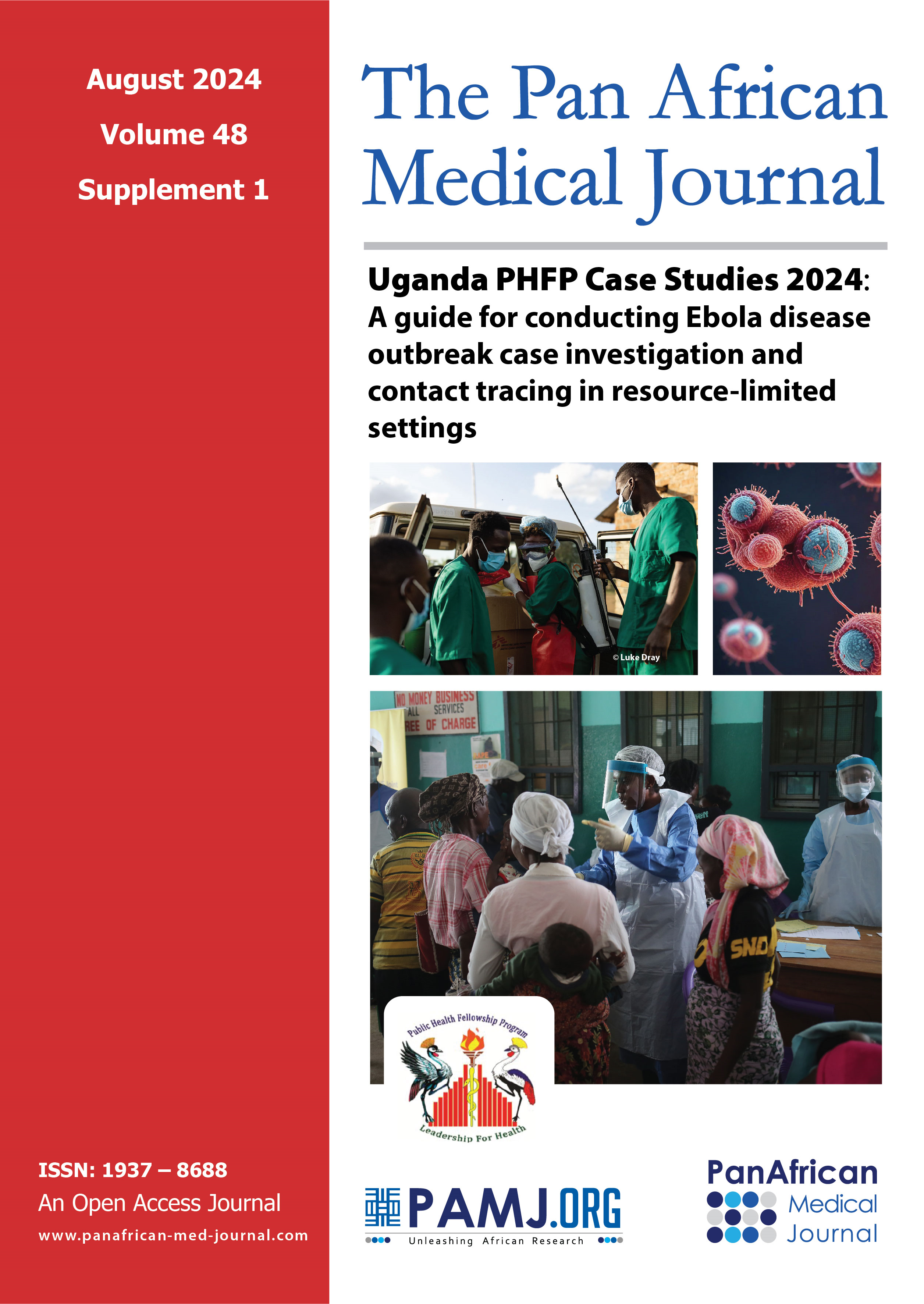
Case studies: a guide for conducting Ebola case investigation and contact tracing in resource-limited and or complex settings
Case studies: a guide for conducting Ebola case investigation and contact tracing in resource-limited and or complex settings
 Lilian Bulage1,&, Richard Migisha1, Rebecca Akunzirwe1, Robert Zavuga1, Patience Mwine1, Mackline Ninsiima1, Carol Nanziri1, Paul Edward Okello1, Elizabeth Katana1, Daniel Kadobera1, Alex Riolexus Ario1, Julie Rebecca Harris2
&Corresponding author

Ebola virus disease (EVD) is a rare and often deadly viral hemorrhagic fever (VHF). Infection is transmitted through direct contact with infectious blood, body fluids, and animal tissues [1]. The first documented EVD outbreak occurred in 1976 in Ebola Zaire and it was designated Ebola Zaire. In the same year, another outbreak occurred in Sudan caused by a different virus strain that was designated Sudan Ebola Virus (SUDV). Since then, there have been several EVD outbreaks, all in sub-Saharan Africa with the most deadly occurring in 2014-2016, in West Africa, where 11,310 deaths and approximately 28,600 cases were recorded [2]. There is no specific treatment or vaccine for SUDV but it exists for the Zaire strain [1].
Uganda has experienced 6 EVD outbreaks since 2000 when the first one occurred [3]. On September 18, 2022, the Uganda Ministry of Health reported a confirmed case of SuDV in Mubende, a rural district located in Central Uganda [4]. Nine weeks later, the outbreak spread to nine other districts including Kampala, the capital city of Uganda [4]. Of the 6 EVD outbreaks Uganda has experienced, the 2000 outbreak was the worst, registering 425 cases and 224 deaths [3]. Since then, Uganda has registered an improvement in response to EVD outbreaks with the most recent i.e. September 2022 only registering 142 confirmed cases and 55 deaths. Despite the many EVD outbreaks being experienced in Africa, Uganda inclusive, no case studies had been written about our experiences to learn from and guide future responses. These outbreaks have been experienced in different settings including rural and complex settings such as Kampala, the capital city of Uganda. Case studies are a detailed examination of a person, a place, or a situation, usually to learn something from it by reviewing the details closely. They´re often meant to help others learn from a difficult situation that someone found themselves in and was able to resolve, with the interest of sharing that knowledge [5]
In this special supplement to the Pan African Medical Journal, we present three important case studies produced by the Uganda Public Health Fellowship Program (UPHFP), the capacity-building arm of the Uganda National Institute of Public Health (UNIPH). This edition brings out case studies that provide a guide for epidemiologists to carry out case investigations and contact tracing during Ebola Disease outbreaks or other viral hemorrhagic fever epidemics in resource-limited and or complex settings. This set of case studies lays out a step-by-step process of conducting epidemiological investigations in real-life scenarios in Uganda. These case studies and other future ones prepared by the UNIPH can be accessed by public health professionals and epidemiologists´ trainers including Field Epidemiology Training Programs in Africa and other resource-limited settings. We are confident that it will build the capacity of young epidemiologists to respond to public health threats in their countries and beyond.

The authors declare no competing interests.
All the authors have read and agreed to the final manuscript.
We acknowledge Training Programs in Epidemiology and Public Health Interventions Network (TEPHINET) for the funding support offered to enable these case studies to be developed. We appreciate the US Centers for Disease Control and Prevention for the unwavering technical and financial support extended to the programs run by the UNIPH. Special gratitude goes to the Ministry of Health leadership for extending unlimited access to health data that enables the UPHFP to generate scientific communication products including these case studies.
- World Health Organization. Ebola virus disease. April 20, 2023. Accessed Jan 31, 2023.
- GOV.UK. Ebola: overview, history, origins and transmission. Updated January 12, 2023. Accessed Jul 25, 2024.
- World Health Organization, Uganda. How Previous Ebola Virus Disease Outbreaks Helped Uganda Respond to COVID-19 Outbreak. August 28, 2020. Accessed on Jul 25, 2024.
- Kiggundu T, Ario AR, Kadobera D, Kwesiga B, Migisha R, Makumbi I. Notes from the Field: Outbreak of Ebola Virus Disease Caused by Sudan ebolavirus - Uganda, August-October 2022. MMWR Morb Mortal Wkly Rep. 2022 Nov 11;71(45):1457-1459. PubMed | Google Scholar
- Training Programs in Epidemiology and Public Health Interventions Network. Case Studies. TEPHINET. Accessed Jul 25, 2024.
Search
This article authors
On Pubmed
On Google Scholar
Citation [Download]
Navigate this article
Similar articles in
Key words
Article metrics
Recently from the PAMJ


Authors´ services
